
A zero liquid discharge system lets your plant treat, reuse, and reclaim almost every drop of wastewater while sending nothing back to the environment. Across the Middle East, Africa, Southeast Asia, the CIS, and South America, tighter discharge rules and rising water costs now push factories toward this approach. Moreover, a well-designed system turns a costly waste stream into clean water and even saleable industrial salt. At Chunke Water Treatment, we design, build, and export complete ZLD plants that pair membrane filtration with thermal evaporation and crystallization.
Throughout this guide, you will learn how the technology works, where it fits, what drives the cost, and how to size a solution for your own feed water. Because every project starts with a water analysis, we also explain why your total dissolved solids (TDS) decide your recovery rate. Let us walk through it step by step.
What Is a Zero Liquid Discharge System?
A zero liquid discharge system is an engineered treatment train that recovers purified water from wastewater and converts the remaining concentrate into dry solids. In short, “zero liquid discharge” means no liquid effluent leaves the site. Instead, the plant returns reusable water to your process and produces a solid salt cake for disposal or sale.
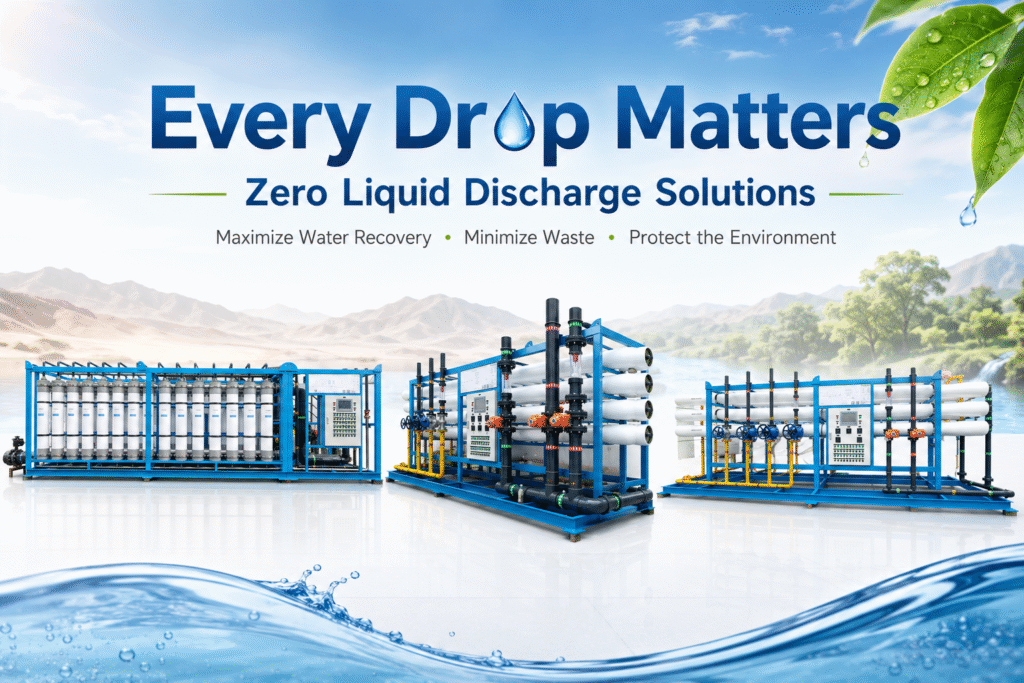
Unlike a single membrane skid, a true ZLD plant combines several technologies in sequence. First, pre-treatment protects the downstream equipment. Next, a high-pressure reverse osmosis system concentrates the dissolved salts. Finally, evaporation and crystallization drive the brine to dryness. Together, these stages reach water recovery rates of 95% to 99%, depending on your feed.
Why Industries Choose Zero Liquid Discharge
Demand for a zero liquid discharge system keeps growing, and three forces drive that trend. Regulations get stricter, fresh water gets scarcer, and recovered resources add real value. Let us look at each one.
Stricter Environmental Regulations
Many governments now ban or heavily restrict the discharge of saline or contaminated effluent into rivers, soil, and the sea. Consequently, mining sites, textile mills, power stations, and chemical plants face fines or shutdowns if they keep dumping brine. A ZLD plant removes that risk because it eliminates the liquid discharge entirely. As a result, you protect both your license to operate and your reputation.
Water Scarcity and Reuse
Water is expensive and, in arid regions, simply hard to find. Therefore, recovering 95% or more of your wastewater cuts your intake of fresh or municipal water dramatically. In many of our projects across the Gulf and North Africa, the recycled water alone pays back a large share of the investment. Furthermore, reliable in-house water improves production stability during droughts and supply cuts.
Resource Recovery — Turning Brine into Industrial Salt
Here is where a modern zero liquid discharge system becomes a profit center rather than a cost. When we crystallize the concentrated brine, your plant can produce industrial salt as a by-product. Depending on the source water chemistry, that salt can be sold to chemical processors, de-icing suppliers, or other industries. Thus, the same equipment that solves a compliance problem also creates a new revenue stream.
How Chunke’s Zero Liquid Discharge System Works
Our engineers build every zero liquid discharge system around your water analysis, your target recovery, and your site conditions. Although each plant is custom, the core process follows four clear stages. Below, we explain how Chunke moves your wastewater from raw effluent to clean water plus dry salt.
Stage 1 — Pre-Treatment
Strong pre-treatment protects the membranes and the thermal units that follow. First, we remove suspended solids, oil, and organics through coagulation, multimedia or ultrafiltration (UF) systems, and activated carbon. Then, we adjust pH and dose antiscalant to keep the reverse osmosis membranes clean. Because fouling is the biggest enemy of any ZLD plant, this stage decides your long-term running cost.
Stage 2 — Membrane Concentration with SWRO or BWRO
Next, we concentrate the dissolved salts using reverse osmosis, since membranes remove water far more cheaply than heat. For lower-salinity effluent, we apply a brackish water reverse osmosis (BWRO) system. For high-TDS streams, we use a robust seawater reverse osmosis (SWRO) system built for high pressure and high salinity. You can also explore our dedicated seawater reverse osmosis desalination plant resources for deeper technical detail.
This membrane stage does the heavy lifting. Effectively, it recovers most of the clean water at low energy cost and shrinks the volume that must go to the evaporator. To keep energy use down, we fit our high-pressure trains with energy recovery devices and reliable pumps from trusted brands such as Grundfos and Danfoss. Likewise, we specify proven RO membranes from DuPont and Hydranautics, housed in certified ROPV membrane pressure vessels.
Stage 3 — Thermal Evaporation
After the membranes reach their concentration limit, the remaining brine moves to the evaporator. At this point, heat does what pressure no longer can. Our evaporators — typically multiple-effect (MED) or mechanical vapor recompression (MVR) units — boil off the water and recover it as high-purity distillate. Meanwhile, the brine grows steadily more concentrated and approaches its saturation point. Because MVR reuses the latent heat of the vapor, it keeps the energy bill of this stage under control.
Stage 4 — Crystallization and Salt Recovery
In the final stage, the saturated brine enters a crystallizer. There, controlled heating and cooling force the dissolved salts to crystallize out of solution. As a result, your plant produces a dry salt cake that a centrifuge or filter press separates from the last traces of liquid. That recovered distillate returns to your process, and the industrial salt becomes a sellable product. Consequently, the loop closes: clean water in, clean water out, and solid salt instead of liquid waste.
| Stage | Technology | Main job | Output |
|---|---|---|---|
| 1. Pre-treatment | UF, media filters, dosing | Protect membranes | Clarified water |
| 2. Concentration | BWRO / SWRO membranes | Recover bulk water | Permeate + brine |
| 3. Evaporation | MED / MVR evaporator | Recover more water by heat | Distillate + concentrate |
| 4. Crystallization | Crystallizer + centrifuge | Dry the brine | Clean water + industrial salt |
Your Recovery Rate Depends on Your TDS
One question shapes every zero liquid discharge system we design: how salty is your feed? Your total dissolved solids decide how much work the membranes can do and how much load passes to the evaporator. In practice, the higher your TDS, the more thermal energy you need, and the more your operating cost rises.
For lower-TDS wastewater, the membrane stage recovers a large share of the water cheaply, so the evaporator and crystallizer stay small. For very high-TDS or near-saturated brine, the membranes reach their limit early, and the thermal stages must handle a bigger volume. Therefore, we always start with a full water analysis before we size any equipment. That single report determines your recovery rate, your energy demand, and your final budget.
Because the chemistry varies so widely, two plants with the same flow can need very different equipment. For example, a textile mill and a mine tailings stream may both want ZLD, yet their salt loads differ sharply. So we tailor the membrane-to-thermal balance for each case, which keeps both your capital cost and your running cost as low as possible.
ZLD vs. Conventional Wastewater Treatment
Many plants still rely on conventional effluent treatment that cleans water only to a discharge standard and then releases it. That approach worked when rules were loose and water was cheap, yet it no longer fits today’s reality. By contrast, a zero liquid discharge system goes much further because it recovers the water for reuse and removes the liquid waste completely.
Consider the difference in outcomes. A conventional plant still leaves you with a salty effluent that you must discharge, truck away, or store in evaporation ponds. Those ponds need land, leak over time, and attract regulatory scrutiny. A ZLD plant, however, replaces that liability with two assets: clean water and dry salt. Therefore, although the upfront investment is higher, the long-term position is far stronger.
There is also a strategic angle. Buyers, auditors, and lenders increasingly judge factories on their environmental footprint. Consequently, a closed-loop water system signals responsible operation and can unlock greener financing or larger customers. In other words, the technology protects compliance today while it strengthens your business case for tomorrow.
How to Plan and Size Your ZLD Project
Good planning prevents expensive surprises, so we follow a clear sequence on every job. First, we collect a full water analysis and your daily flow figures. Second, we define your reuse target and any limits on energy, footprint, or budget. Third, we balance the membrane and thermal stages to hit that target at the lowest total cost. Finally, we confirm the salt quality you can expect from your specific brine.
This disciplined method matters because no two effluents behave alike. A small change in calcium, silica, or organics can shift the whole design. Hence, our engineers test, model, and validate before they finalize a single drawing. That care is what separates a system-driven manufacturer from a parts trader.
Key Components and Trusted Brands
A zero liquid discharge system runs around the clock, so component quality matters more than headline price. For that reason, Chunke builds every plant with internationally recognized brands rather than the cheapest available parts. This system-driven approach keeps your plant reliable and easy to service anywhere in the world.
Our automation runs on dependable Siemens PLC and HMI controls, while motor protection and power distribution use Schneider Electric components. For corrosion-resistant pipework, we install +GF+ (Georg Fischer) piping. In addition, accurate flow, pressure, and conductivity readings come from Endress+Hauser instrumentation. Together, these brands give you a plant that meets international standards and earns easy approval from your engineers and consultants.
Industries and Applications
Almost any sector that produces salty or contaminated wastewater can benefit from a zero liquid discharge system. Over the years, our team has delivered solutions for many demanding environments. The most common applications include the following:
- Mining and metals — managing tailings and acid mine water, as covered on our water treatment for mining and metals page.
- Textile and dyeing — recovering water and salt from high-color, high-TDS effluent.
- Power generation — treating cooling-tower blowdown and boiler reject.
- Chemical and pharmaceutical — closing the loop on process wastewater.
- Landfill leachate — paired with our DTRO leachate treatment equipment for very dirty, high-pressure streams.
- Food, beverage, and tannery — meeting strict local discharge limits.
Whatever your industry, the goal stays the same: keep the water on site, stay compliant, and recover value from the waste.
Containerized and Custom ZLD Solutions
Not every site has space for a large fixed plant, and many of our customers need fast deployment. For those projects, we package the membrane stages inside a standard shipping container. Our containerized water treatment systems arrive pre-assembled, pre-wired, and factory-tested, so installation takes days rather than months. Moreover, a containerized layout suits remote mines, islands, and temporary sites where civil work is limited.
For larger flows, we engineer skid-mounted or building-based plants instead. Either way, we match the design to your footprint, climate, and logistics. Because we control engineering, fabrication, and testing in our own factory, we keep quality consistent from the first drawing to the final commissioning.
Zero Liquid Discharge System Cost
Buyers always ask about price, and the honest answer is that cost depends on your water. Specifically, your flow rate, your TDS, and your target recovery shape both the capital and the operating cost of a zero liquid discharge system. The thermal stages use the most energy, so a high-TDS feed naturally costs more to run than a low-TDS one.
To control the total cost of ownership, we push as much separation as possible onto the low-energy membrane stage before the brine reaches the evaporator. In addition, we use MVR and energy recovery to cut power use, and we recover salable salt to offset operating expenses. For a wider view of desalination economics, see our guide on how much a desalination plant costs. After we review your water report, we provide a clear, itemized quotation with no hidden extras.
Why Choose Chunke as Your ZLD Manufacturer
Chunke (Guangzhou Chunke Environmental Technology Co., Ltd.) is a professional, system-driven manufacturer, not a price-driven trader. For more than fifteen years, we have designed, engineered, and exported water and wastewater systems to over 100 countries. As a result, we understand the regulations, climates, and logistics that shape projects in your region.
When you work with us, you get one accountable partner for the whole zero liquid discharge system — pre-treatment, RO, evaporation, crystallization, controls, and after-sales support. Our ISO 9001 certified factory builds each plant with the trusted brands listed above, and our engineers guide you from water analysis through commissioning and training. Because we manufacture in-house, we also keep spare parts and technical help within easy reach.
In short, you gain compliance, water savings, and recovered industrial salt from a single supplier you can trust. That combination is exactly why customers across the Middle East, Africa, Southeast Asia, the CIS, and South America keep coming back to Chunke.
Get a Tailored Zero Liquid Discharge System Proposal
Ready to stop discharging wastewater and start recovering water and salt? Then let our engineers design a zero liquid discharge system around your exact feed water and goals. Simply send us your water analysis and target flow, and we will respond with a tailored solution and quotation. Fill in our contact form here, and our team will reach out to you shortly.
Best regards,
David
Chunke Water Treatment — www.chunkewatertreatment.com