
An ultrafiltration system for water treatment is one of the most reliable ways to remove bacteria, viruses, colloids and suspended solids from almost any water source, and it does this without adding a single chemical. At Chunke, we design and export these systems to clients across the Middle East, Southeast Asia, Africa, the CIS and South America. Therefore, in this guide I will explain exactly how the technology works, what it can and cannot do, the specifications you should compare, and how to choose the right configuration for your project.
Whether you need clean process water for a factory, safe drinking water for a community, or dependable pre-treatment ahead of a reverse osmosis plant, ultrafiltration delivers consistent results. Let us walk through the details together.
What Is an Ultrafiltration System for Water Treatment?
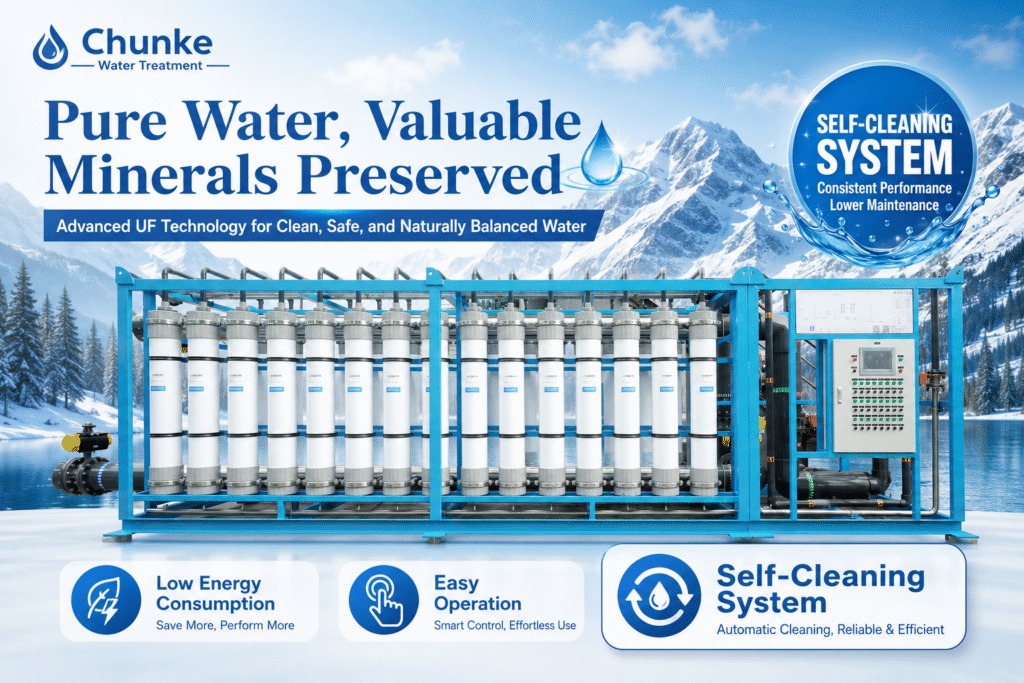
An ultrafiltration system for water treatment uses hollow-fiber membranes with extremely fine pores to physically separate contaminants from water. Unlike a sand filter or a cartridge filter, UF works as an absolute barrier. As a result, particles larger than the pore size simply cannot pass through.
The membranes typically have a pore size between 0.01 and 0.1 microns. Consequently, they capture bacteria, protozoa, most viruses, colloidal silica, and fine turbidity. Meanwhile, dissolved minerals and salts pass through, which means UF keeps the natural mineral balance of the water intact.
Because it removes pathogens by size exclusion rather than chemistry, ultrafiltration produces water with very low and stable turbidity, often below 0.1 NTU. Moreover, the filtrate quality stays consistent even when the incoming raw water quality swings up and down. For more background on how membrane separation fits into the wider picture, see our overview of the complete water filtration process.
How UF Membranes Actually Work
Inside each module sit thousands of tiny hollow fibers. Water flows either from the outside of the fiber to the inside, or from the inside to the outside, depending on the design. The clean filtrate collects in the center channel, while rejected solids stay behind on the membrane surface.
Over time, those rejected solids build up. To handle this, the system runs an automatic backwash every 30 to 60 minutes, plus a periodic chemically enhanced backwash (CEB). Thanks to this self-cleaning cycle, a well-designed UF unit can run for years on the same set of membranes.
It also helps to picture the size scale involved. A human hair measures roughly 75 microns across, while bacteria sit around 0.5 to 5 microns. Since a UF membrane pore is about 0.02 microns, even the smallest bacteria cannot squeeze through. Viruses are smaller still, yet most of them attach to larger particles and get caught as well. Therefore, the filtrate stays microbiologically safe batch after batch, which is exactly why an ultrafiltration system for water treatment has become the modern standard for surface-water and reuse projects.
How Does an Ultrafiltration System Work, Step by Step?
Understanding the full process flow helps you size and budget the plant correctly. Here is how a typical Chunke ultrafiltration system for water treatment moves water from raw intake to finished filtrate.
First, raw water passes through a self-cleaning pre-filter or multimedia filter to remove large debris. Next, a feed pump pushes the water into the UF membrane modules at controlled pressure. Then the membranes separate the clean filtrate from the rejected solids. After that, the filtrate either goes straight to your storage tank or feeds the next treatment stage. Finally, the PLC automatically triggers backwash and CEB cycles to keep the membranes clean.
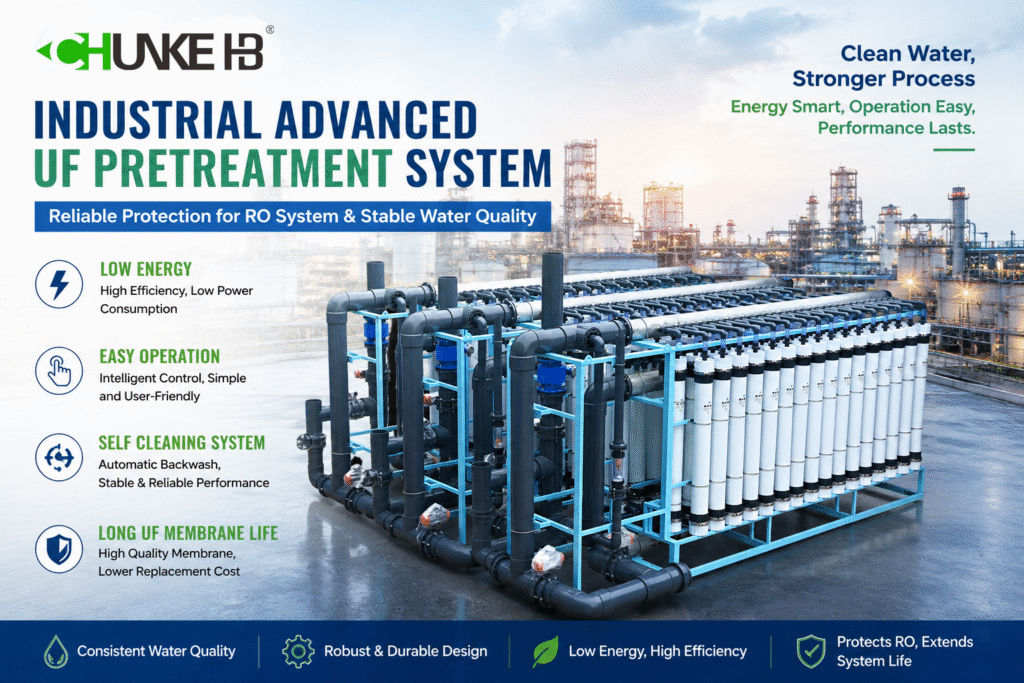
For projects that need higher-purity water afterward, UF makes an excellent front end for a downstream reverse osmosis water purification unit. In fact, protecting RO membranes is one of the most common reasons our customers buy UF in the first place.
Ultrafiltration vs Reverse Osmosis: Which One Do You Need?
People often ask whether they should buy UF or RO. In truth, they solve different problems, and frequently they work best together. UF removes particles, bacteria and viruses but leaves dissolved salts in place. RO, on the other hand, removes dissolved salts and minerals as well.
So if your raw water is fresh but biologically unsafe or turbid, ultrafiltration alone may be enough. However, if you need to lower TDS, soften the water, or desalinate seawater, then you need reverse osmosis, and UF becomes the pre-treatment that protects those expensive RO membranes. You can explore our full range of industrial water treatment options to see how the stages combine.
For seawater projects in particular, robust pre-treatment is critical, and our team builds matched UF-plus-SWRO trains. You can read more about complete desalination packages on our partner site swro-plant.com, which focuses specifically on seawater reverse osmosis plants.
Key Benefits of Ultrafiltration for Industrial Water Treatment
This technology offers advantages that older filtration methods simply cannot match. Below are the benefits our customers value most, and together they explain why demand keeps rising across every region we serve.
Chemical-free disinfection. Because UF removes pathogens physically, you can cut back heavily on chlorine and other disinfectants. As a result, you spend less on chemicals and produce safer water for sensitive applications.
Stable, high-quality output. UF delivers consistent turbidity below 0.1 NTU and a Silt Density Index (SDI) under 3, regardless of feed-water swings. Consequently, any downstream RO membranes enjoy a much longer service life.
Compact footprint. Compared with conventional clarifiers and sand-filter trains, a UF skid takes up far less floor space. Therefore, it suits crowded plant rooms and containerized builds alike.
Fully automatic operation. With PLC control, automatic backwash and CEB, the system needs very little daily attention. Even better, operators in remote sites can run it with minimal training.
Long membrane life. When you feed it properly and follow the cleaning schedule, a UF membrane set lasts five years or more. For best practice, our guide on membrane cleaning techniques applies to UF cleaning as well.
Where Ultrafiltration Systems Are Used
The flexibility of ultrafiltration makes it suitable for a wide range of industries and regions. Across our export markets, we see the same applications come up again and again.
Drinking Water and Community Supply
Municipalities and rural communities use UF to turn river, lake, borehole or well water into safe drinking water. Since UF removes bacteria and viruses without chemicals, it is ideal for areas where chlorine handling is difficult. It also pairs well with our broader industrial water treatment solutions.
Industrial Process Water
Factories in food and beverage, electronics, textiles, pharmaceuticals and chemicals rely on UF for clean, particle-free process water. Furthermore, many of them place UF directly ahead of RO or EDI to protect those stages.
Seawater and Brackish Water Pre-Treatment
Hotels, islands, ships and coastal industries use UF before seawater reverse osmosis. Because UF guarantees a low SDI, the SWRO membranes foul far more slowly. Our dedicated seawater desalination systems often ship with a UF front end for exactly this reason.
Wastewater Reuse and Recycling
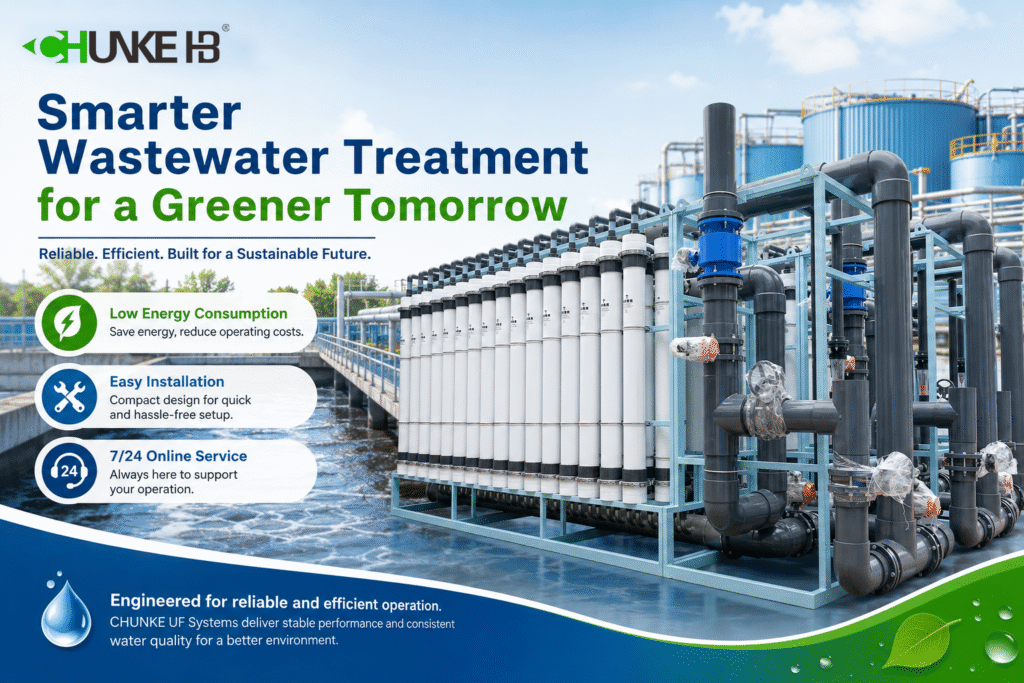
As water costs rise, more clients reuse treated effluent. UF polishes secondary wastewater so it can be recycled for cooling towers, irrigation or further RO treatment. In this way, factories cut both their water bills and their discharge volumes.
Technical Specifications and Capacities
When you compare suppliers, look beyond the price tag and study the specifications closely. Here are the key parameters of a Chunke ultrafiltration system for water treatment.
Capacity range. We build systems from 0.5 m³/h for small sites up to 500 m³/h and beyond for municipal and industrial plants. Moreover, we scale capacity by adding membrane modules in parallel, so your plant can grow with demand.
Membrane type. We use PVDF hollow-fiber membranes for their chemical resistance and mechanical strength. These handle frequent backwash and CEB cycles without failing.
Pore size. The standard pore size sits between 0.02 and 0.03 microns, which reliably blocks bacteria and most viruses.
Operating pressure. UF runs at low pressure, usually 1 to 3 bar, so energy consumption stays low compared with RO.
Recovery rate. Typical water recovery ranges from 90% to 95%, depending on feed quality and backwash settings.
Control. Every system ships with a PLC and HMI for fully automatic operation, plus remote monitoring on request. To see how UF fits into a turnkey build, browse our RO filter system range, which we frequently combine with UF.
Components We Build Into Every Chunke UF System
A water treatment plant is only as reliable as the parts inside it. For that reason, we specify trusted international brands rather than the cheapest available components. This is a core part of how we work as a system-driven manufacturer, not a price-driven trader.
For membranes, we work with proven names such as Toray, DuPont and LG Chem, and we match the membrane to your exact water chemistry. For the high-flow feed and backwash pumps, we rely on Grundfos and CNP to keep operating costs predictable.
On the control side, we build panels around Siemens PLC and HMI together with Schneider Electric protection gear. In addition, we use +GF+ piping and Endress+Hauser instrumentation so that flow, pressure and turbidity readings stay accurate for the life of the plant. Because we standardize on these brands, spare parts remain easy to source anywhere in the world.
How to Choose the Right Ultrafiltration System
Before you request a quotation, gather a few key facts. With this information, our engineers can size your system accurately the first time.
Start with your raw water source and a recent water analysis, including turbidity, TDS, SDI and bacterial load. Next, decide your required flow rate in cubic meters per hour and your daily operating hours. Then define the end use, since drinking water, RO pre-treatment and wastewater reuse each call for different settings.
Also consider your site constraints. For remote or fast-track projects, a containerized UF plant ships ready to run and installs in days, not months. Finally, think about future growth, because a modular design lets you add capacity later without replacing the whole system. If you are still comparing technologies, our article on water demineralization helps clarify when you need salt removal as well as particle removal.
Maintenance and Operating Costs You Should Plan For
Buyers often focus on the purchase price, yet the running cost decides the true value over ten years. Fortunately, UF is one of the cheapest membrane technologies to operate, and a little planning keeps it that way. Below, I break down each cost so you can budget with confidence and avoid surprises after installation.
Energy is the first cost. Because UF runs at only 1 to 3 bar, the feed pump draws far less power than an RO high-pressure pump. As a result, your electricity bill stays modest even on large plants.
Chemicals come next, but the demand is small. You will use some sodium hypochlorite, caustic and citric acid for the periodic CEB and for the occasional clean-in-place (CIP). Still, the volumes are low because backwash does most of the cleaning physically.
Membrane replacement is the largest scheduled cost, yet it arrives slowly. With correct pre-treatment and disciplined cleaning, PVDF fibers commonly last five to eight years. Moreover, you replace modules one rack at a time, so you never face a single large bill. To stretch membrane life further, follow a clear cleaning schedule and log every CIP, just as we recommend for our wider industrial RO water filtration systems.
Finally, budget for basic consumables such as pre-filter cartridges and instrument calibration. Even so, when you add everything together, the total cost of ownership stays low and predictable, which makes UF an easy investment to justify.
Why Buy Your Ultrafiltration System from Chunke
Guangzhou Chunke Environmental Technology Co., Ltd. designs, manufactures and exports complete water treatment systems, and we have done so for clients on five continents. As a result, we understand the shipping, voltage, climate and water-chemistry challenges of overseas projects.
We do not sell a box and disappear. Instead, we provide full engineering support, detailed drawings, installation guidance, commissioning help and after-sales service. Furthermore, every system goes through factory testing before it leaves our workshop, so it arrives ready to perform.
Because we control the whole build, from membrane selection to PLC programming, we deliver a system that fits your water and your budget rather than a generic unit. To see the wider catalogue, visit our main site at chunkewatertreatment.com, where you will find RO, SWRO, UF, EDI and containerized systems all in one place.
Get a Quote for Your Ultrafiltration System for Water Treatment
If you are ready to move forward, the next step is simple. Tell us about your water source, your required flow rate and your application, and our engineers will design a solution and send you a clear quotation.
Please fill in the contact form on our website with your project details, and our team will reach out to you promptly to discuss your ultrafiltration system for water treatment. Let us help you turn any water source into clean, safe, reliable water.
— David, Chunke Water Treatment