
An RO system for oil and gas industry sites has to survive conditions that would shut down an ordinary reverse osmosis plant within months. Desert heat, sour gas, salt spray, and explosive atmospheres are simply part of daily operation on a well pad, a gathering station, or an offshore platform. Consequently, oil and gas operators cannot buy a standard commercial RO skid and expect it to hold up. They need equipment engineered from the ground up to survive hazardous zones, deliver consistent water quality, and pass the strict inspections that international EPC contractors demand.
At Chunke Water Treatment, we design our reverse osmosis systems specifically around the codes and standards that oil and gas projects require. This guide walks through those standards, explains how each one shapes the equipment, and gives you the technical background to specify or evaluate a system with confidence.
Why Oil and Gas Operations Need a Purpose-Built RO System
Standard industrial reverse osmosis equipment is built for factories, hotels, and municipal plants where the environment stays relatively controlled. Oilfield sites are a different story entirely. Hydrocarbon vapors linger near wellheads and separators, so any electrical equipment nearby must be rated for hazardous areas. Sand, dust, and extreme temperature swings attack pumps, seals, and instrumentation. Meanwhile, feed water quality can shift dramatically between groundwater wells, seawater intakes, and produced water sources, forcing the system to adapt without constant operator intervention.
Because of these conditions, a properly engineered RO system for oil and gas industry service needs three things that a generic RO skid does not: certified explosion protection, corrosion-resistant construction rated for the specific feed water chemistry, and documentation that satisfies third-party inspection agencies before the equipment ever leaves the factory. Skipping any of these three elements creates a liability that shows up later, usually during commissioning or the first major sandstorm.
Matrial Selections
Material selection compounds these challenges further. Produced water and seawater both carry chlorides that attack ordinary stainless steel, so critical wetted components on an oil and gas RO skid typically move to super duplex or 316L stainless steel, along with FRP or GFS tankage where appropriate. Choosing the wrong material grade at the design stage often shows up as pitting corrosion within the first year or two of service, long before the membranes themselves would normally need replacement.
Downtime on an oil and gas site also carries a much higher cost than downtime at a typical commercial facility. A rig or gathering station without utility water can halt drilling, delay a fracturing job, or force an operator to truck in water at considerable expense. That reality is why reliability, not just upfront price, drives the purchasing decision for most oil and gas water treatment procurement teams.
Environmental compliance adds another layer that generic RO suppliers rarely account for. Discharge permits for concentrate, produced water reinjection limits, and local environmental authority reporting all vary by country, and a manufacturer familiar with these regional requirements can design the system to meet them from day one. Retrofitting a skid to satisfy an environmental permit after installation almost always costs more than designing around it up front, so this consideration belongs in the earliest conversations with your equipment supplier.
Engineering Standards Behind Every RO System for Oil and Gas Industry Project
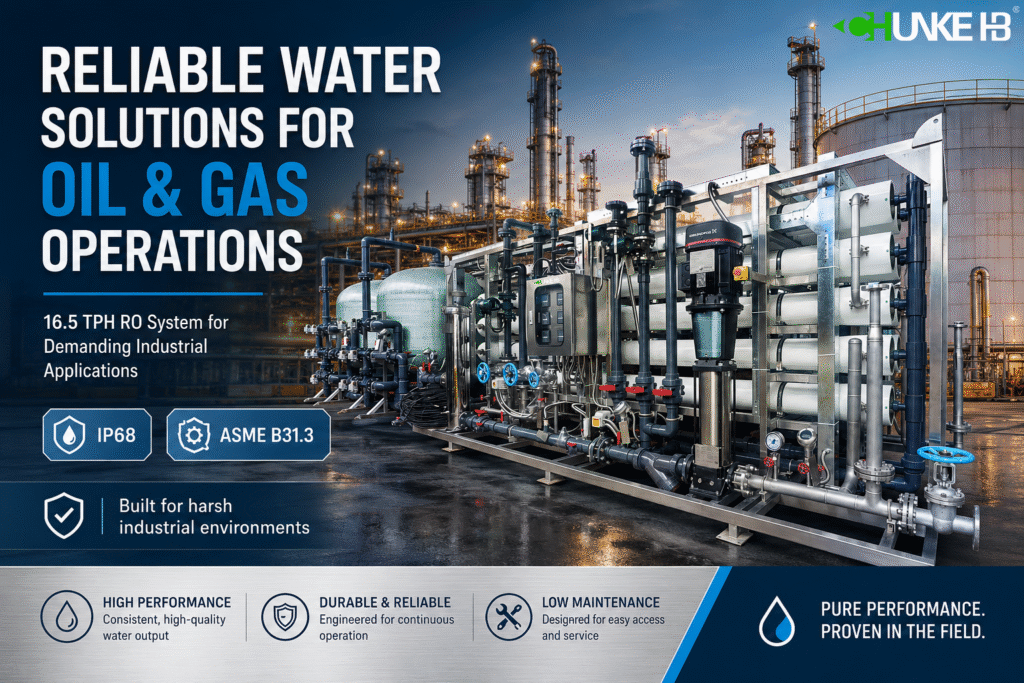
Every reverse osmosis order we build for oil and gas clients follows a defined set of codes, agreed with the client before fabrication begins. These standards touch the structure, the electrical design, the instrumentation, and the pressure components. Below is a breakdown of each one and why it matters on site.
Skid Frame and Steel Structure – AISC Standard
The skid frame carries the entire weight of the installation, including pumps, vessels, piping, and the control cabinet, often during crane lifts and rough transport to remote sites. We fabricate our frames to the AISC standard, which governs structural steel design in the United States and is widely accepted by EPC contractors worldwide. This ensures the frame resists the stresses of overland transport, offshore lifting, and years of vibration from pumps and compressors without fatigue cracking.
Motor and Drive Compliance – IEC Standard
Motors on an oilfield RO skid run continuously, often in ambient temperatures above 45°C. We select IEC-rated motors so voltage, frequency, insulation class, and enclosure ratings align with electrical infrastructure across the Middle East, Africa, and the CIS region, three of our largest export markets. Pairing IEC motors with Schneider Electric or Siemens variable frequency drives lets the system adjust pump speed to match changing feed pressure, which reduces energy consumption and extends motor life.
Explosion-Proof Design – ATEX Certified EEx-de Zone 2 IIA T3
Because flammable gas can be present near wellheads, separators, and tank batteries, every electrical enclosure on our explosion proof RO systems carries ATEX certification rated EEx-de Zone 2 IIA T3. This rating confirms the equipment is safe to operate in an area where an explosive atmosphere is unlikely during normal operation but could occur occasionally. Explosion-proof junction boxes, motor terminal boxes, and control panels all carry this certification, and each component ships with its ATEX documentation for the client’s HSE file.
Instrument Protection – IP65 / IP68
Sand, humidity, and pressure washdowns are routine on an oilfield site, so instrumentation needs a sealed enclosure rating. We specify IP65 for panel-mounted devices exposed to dust and water jets, and IP68 for submerged or heavily wetted sensors such as level transmitters in the feed tank. This protects the sensitive electronics inside every gauge, transmitter, and switch from the harsh environment surrounding the system.
Communication Protocol – HART
Our instrumentation communicates over the HART protocol, layering digital diagnostic data on top of the standard 4-20mA analog signal. This lets the operator read calibration status, diagnostics, and configuration data remotely, through instruments from Endress+Hauser or similar HART-compatible brands, without opening a single enclosure in a hazardous zone.
PLC Safety Integrity – SIL2
The programmable logic controller that runs the system is rated to Safety Integrity Level 2 (SIL2), meaning the safety functions it performs, such as high-pressure shutdown or low-level pump protection, meet a quantified probability of failure on demand. For oil and gas clients whose safety case requires SIL-rated logic on all utility systems, this rating is often a non-negotiable specification, not an optional upgrade.
Metering Pump Standard – API 675
Chemical dosing, whether for antiscalant, biocide, or pH adjustment, runs through metering pumps built to API 675, the American Petroleum Institute standard for positive displacement pumps used in petroleum, chemical, and gas industry services. API 675 compliance covers materials, seal design, and performance testing, giving procurement teams the documentation their internal specifications typically require.
Multimedia Filter Tank – ASME Section VIII Division 1
Pretreatment tanks that filter suspended solids ahead of the RO membranes are pressure vessels, and we build them to ASME Section VIII Division 1. This code governs design, materials, fabrication, inspection, and testing of pressure vessels, and it is the code most oil and gas EPC contractors specify by default for any pressurized tank on a process skid.
Flange Standard – ASME B16.5
All flanged connections on an oil and gas RO skid follow ASME B16.5, which standardizes dimensions, pressure-temperature ratings, and bolting patterns for pipe flanges from half an inch to 24 inches. Using this standard means our skids bolt directly into a client’s existing piping network without custom adapters or field modifications.
Piping Standard – ASME B31.3
Process piping on the skid is designed, fabricated, and tested to ASME B31.3, the code for process piping used across refineries, chemical plants, and oil and gas facilities. This standard governs wall thickness calculations, welding procedures, and pressure testing, which matters because the skid piping typically operates under continuous high pressure from the feed pumps.
GFS Tank Standard – AWWA D103-09
When a project calls for a glass-fused-to-steel (GFS) storage tank, whether for raw water, product water, or backwash storage, we build it to AWWA D103-09. This American Water Works Association standard governs the factory-coated steel panels used in bolted tanks, giving the client decades of corrosion resistance without the maintenance burden of a painted or unlined carbon steel tank.
Core Components That Determine Performance
Standards define the safety and structural envelope of the system, but component selection determines how well it actually performs in the field. We pair certified engineering with proven brands so operators get equipment they can service anywhere in the world.
Membranes sit at the heart of any RO system for oil and gas industry design. Depending on feed water chemistry and required rejection rate, we specify elements from Toray, DuPont, Hydranautics, Vontron, or LG, matching membrane type to the salinity and fouling potential of the source water. Seawater feeds for a coastal terminal call for a different element than brackish groundwater feeding an inland drilling camp, and our engineering team selects accordingly rather than defaulting to one membrane for every project.
High-pressure feed pumps also vary by project. We source pumps from Danfoss, Grundfos, and CNP, choosing between stainless steel multistage centrifugal and positive displacement designs depending on the required flow, pressure, and duty cycle. Membrane housings come from ROPV, rated for the operating pressure of seawater or brackish water service.
Piping and fittings on the skid frequently use +GF+ piping systems for chemical dosing and low-pressure lines, chosen for their corrosion resistance against antiscalant and cleaning chemicals. On the control side, operators interact with the system through a Siemens HMI, while Createc or Endress+Hauser instruments handle continuous water quality monitoring for conductivity, turbidity, and pH.
None of these brands appear on the skid by accident. Each one has a track record in oil and gas service, and each carries the certifications and spare parts availability that keep a remote installation running without waiting months for an obscure replacement part.
Applications Across Oil and Gas Operations
An RO system for oil and gas industry deployment rarely does just one job. Depending on where it sits in the process, it might supply feed water for steam generation, protect downstream equipment, or simply keep a remote camp supplied with safe drinking water.
Drilling operations need makeup water for mud systems, and mud engineers care about total dissolved solids because high TDS interferes with mud chemistry and additive performance. Correcting source water quality before it ever reaches the mud tanks prevents that interference at the source.
Boiler feed water for steam-assisted gravity drainage (SAGD) and other thermal recovery projects demands extremely low silica and hardness levels, since scale inside a boiler tube reduces heat transfer and can eventually cause a tube failure. RO pretreatment, often paired with our EDI electrodeionization systems for final polishing, delivers that water quality reliably.
Cooling towers at compressor stations and gas processing plants also benefit from RO-treated makeup water, since lower dissolved solids reduce scaling and extend the service life of the cooling system. Offshore platforms and remote onshore camps need potable water for personnel too, and a seawater reverse osmosis system converts seawater directly into safe drinking water without depending on barged-in supply.
Produced water reinjection makeup and hydraulic fracturing fluid preparation round out the list, and both rely on consistent water chemistry. An RO system gives the operator that consistency regardless of what the source water looks like on any given day.
Maintenance and Long-Term Reliability in Harsh Environments
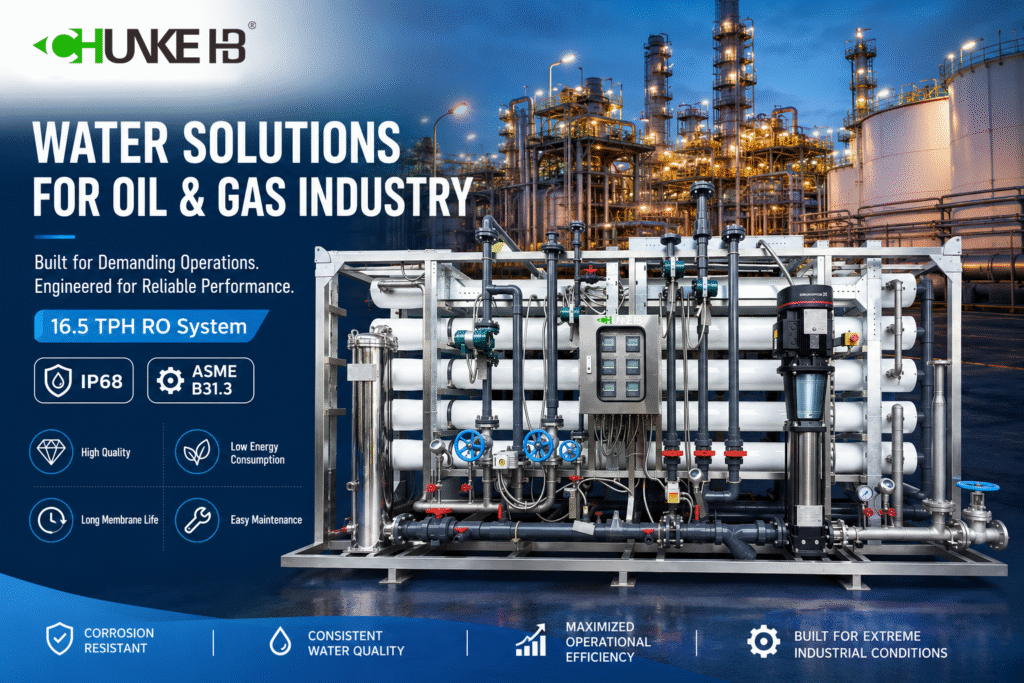
Even a perfectly engineered system needs consistent maintenance to hit its full membrane life, typically three to seven years under normal fouling conditions. Regular CIP membrane cleaning removes scale, biofilm, and organic fouling before it permanently damages the membrane surface, and we size the CIP skid to match the main system so operators can run a full cleaning cycle without disassembling the main process line.
Pretreatment quality has the single biggest impact on membrane life. A properly sized multimedia filter ahead of the RO train removes suspended solids before they reach the membrane surface, while cartridge filtration provides a final safety barrier. For sites with elevated biological activity, we add a UV sterilizer to control bacterial growth without introducing additional chemical dosing.
Energy consumption is another area where design choices compound over years of operation. Seawater applications benefit significantly from energy recovery devices, which capture pressure energy from the concentrate stream and feed it back into the process, cutting specific energy consumption substantially compared with a system running without recovery. Our engineering approach on this front draws on the same energy recovery technology we deploy across seawater desalination projects worldwide, adapted for the pressure and flow profile of an oilfield RO skid.
Together, disciplined pretreatment, scheduled cleaning, and smart energy recovery keep operating costs predictable over the life of the system, which matters enormously to an operator managing a multi-year field development budget.
Capacity, Recovery Rate, and Typical Specifications
Capacity requirements vary enormously across oil and gas projects, from a 5 m³/day skid supplying a small well pad camp to a 500 m³/day system feeding an entire gas processing complex. The table below outlines typical specifications we design around for oil and gas clients, though every order is engineered to the specific feed water and site data a client provides.
| Parameter | Typical Range |
|---|---|
| Feed water source | Brackish well water, seawater, produced water (post-pretreatment) |
| Capacity | 5 – 1,000+ m³/day per skid |
| Recovery rate | 35–50% (seawater), 65–85% (brackish) |
| Operating pressure | 10–65 bar, depending on feed salinity |
| Salt rejection | ≥99.2% per membrane element |
| Skid dimensions | Custom, sized for 20ft/40ft container or flat rack transport |
| Power supply | 380V/400V/415V, 50/60Hz, IEC-rated motors |
| Explosion protection | ATEX EEx-de Zone 2 IIA T3 (Zone 1 available on request) |
Skid-Mounted vs Containerized RO Systems for Oil and Gas Sites
Oil and gas clients typically choose between two physical formats for their reverse osmosis package: an open skid or a fully enclosed container.
An open skid mounts every component, pumps, vessels, filters, and control panel, onto a single structural steel base, ready to bolt down inside an existing process building or under a purpose-built shelter. This format suits sites that already have infrastructure in place and simply need the treatment package integrated into it.
A containerized RO system, by contrast, houses the entire process inside a modified shipping container, complete with lighting, ventilation, air conditioning, and often a small workshop area. This format works well for greenfield sites with no existing structure, for remote locations where construction crews are limited, and for operators who may need to relocate the equipment to a new well pad once the current one depletes. Our containerized SWRO system design, originally developed for island and marine desalination projects, translates directly to offshore oil and gas platforms facing similar space and mobility constraints.
Either format can carry the same explosion-proof rating, the same SIL2 control logic, and the same code compliance discussed earlier in this guide. The decision usually comes down to site infrastructure, mobility requirements, and how quickly the project needs the system operational.
How to Choose the Right RO System for Your Oil and Gas Project
Selecting the right system starts with a detailed feed water analysis, since TDS, hardness, silica, oil and grease content, and hydrocarbon traces all influence pretreatment design. Skipping this step is the single most common reason a system underperforms after startup.
Site classification comes next. An operator needs to confirm the hazardous area zone, whether Zone 1 or Zone 2, and the gas group and temperature class required, since this determines the exact ATEX or IECEx rating the electrical package must carry.
Capacity planning should account for future expansion, not just current demand. Because retrofitting a skid to add capacity later is far more expensive than sizing it correctly the first time, we recommend clients discuss five-year water demand projections during the initial engineering phase.
Documentation requirements deserve early attention too. Large EPC-managed projects often require a full data book, including material certificates, hydrotest records, ATEX certificates, and third-party inspection reports, before the equipment can even ship. Confirming these requirements before fabrication begins avoids costly delays at the final inspection stage.
Local service support matters more in oil and gas than in almost any other RO application. A membrane replacement or pump seal failure at a remote well pad can idle an entire operation, so working with a manufacturer that stocks spare parts and understands your specific site conditions makes a measurable difference over the equipment’s operating life.
Total cost of ownership deserves more weight in the decision than the purchase price alone. Two skids can carry an identical price tag on the quotation and still diverge sharply in lifetime cost once energy consumption, membrane replacement frequency, and unplanned downtime enter the calculation. A cheaper skid built from mismatched components often loses that apparent savings within the first two years of operation, while a system engineered around the standards covered in this guide tends to hold its performance and its resale value far longer. Evaluating suppliers on engineering depth, not just on the bottom line of a quotation, protects the project budget over the full life of the asset.
Why International Oil and Gas Operators Choose Chunke
Chunke Water Treatment has manufactured RO, UF, and EDI systems since 2009, and oil and gas clients across the Middle East, Africa, Southeast Asia, the CIS, and South America now rely on our equipment for drilling water, produced water makeup, and camp utility supply. Our engineering team builds every order to the exact standards outlined in this guide, from AISC-rated skid frames to SIL2-rated control logic, and we back that engineering with a full documentation package for your HSE and QA/QC teams.
Beyond the technical specification sheet, we understand that oil and gas procurement runs on trust built over multiple projects. That is why we work directly with EPC contractors and operators from the earliest design stage, adjusting our standard skid platform to match project-specific requirements rather than asking the client to compromise on their specification. You can review examples of our completed projects across Africa, Asia, and South America to see how this approach performs across different climates and site conditions.
If your project needs a properly engineered, code-compliant RO system for oil and gas industry service, our team is ready to review your feed water data and site requirements. Fill in the contact form below, and a Chunke engineer will reach out to discuss your specification, timeline, and budget.
David
Marketing Manager, Chunke Water Treatment