
Irrigation water quality for blueberries is one of the most overlooked factors behind poor yields, leaf burn, and stunted bushes on otherwise well-managed farms. Blueberries are shallow-rooted, acid-loving plants with very low tolerance for salts, and even water that looks perfectly clean to the eye can carry enough dissolved minerals to quietly choke root uptake over a season. Growers who invest heavily in soil amendment, netting, and pruning sometimes miss the one input that touches every plant every single day: the water itself.
This matters even more once fertigation enters the picture. Injecting soluble fertilizer through drip lines is the most efficient way to feed blueberries, but every gram of fertilizer salt you add stacks directly on top of whatever total dissolved solids, or TDS, already exist in your source water. If your base water is already marginal, fertigation can push the root zone past the salinity threshold blueberries can tolerate, and by the time symptoms show on the leaves, the damage to the root system is often already done.
In this guide, we’ll walk through the specific TDS, EC, boron, chloride, and sodium thresholds blueberries need, why fertigation lowers your safe ceiling even further, and how a properly designed reverse osmosis system brings problem water back within range without stripping out the minerals your plants still need.
Why Blueberries Are So Sensitive to Water Quality
Unlike many tree fruits, blueberries have a fine, shallow root system with almost no root hairs. This structure is excellent at scavenging nutrients from acidic, well-aerated soil, but it also means the roots have very little buffering capacity against salt stress. When dissolved salts build up around the root zone, osmotic pressure makes it harder for the plant to absorb water, even when the soil is technically moist.
Consequently, growers often see symptoms that look like drought stress or nutrient deficiency, when the real cause is salinity from irrigation water. Leaf margin scorch, reduced shoot growth, and premature fruit drop are classic signs. Meanwhile, because blueberries also require a fairly narrow soil pH range of 4.5 to 5.5, water with high bicarbonate content compounds the problem by pushing the root zone toward alkalinity over time.
For growers exporting fruit or supplying premium retail markets, consistency matters just as much as total yield. Uneven water quality across a season produces uneven fruit size and sugar content, which directly affects grading and price. This is precisely why serious commercial operations test and treat their irrigation water rather than assume “clean” water is automatically “safe” water.
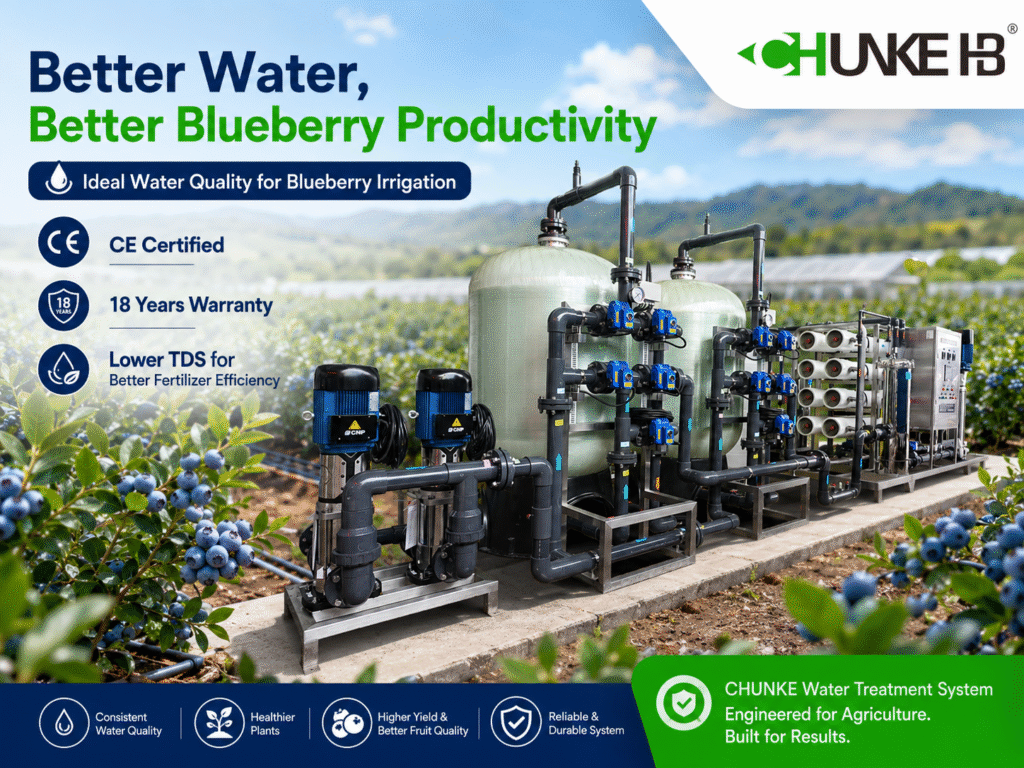
Understanding TDS, EC, and Salinity in Irrigation Water
Total dissolved solids, or TDS, measures the combined weight of all minerals, salts, and organic matter dissolved in water, typically expressed in parts per million (ppm) or milligrams per liter. Electrical conductivity, or EC, measures how easily that water conducts an electric current, which rises in direct proportion to dissolved salt content. Growers and agronomists often move between the two: as a rough rule of thumb, 1 dS/m of EC equals roughly 640 ppm of TDS.
Neither TDS nor EC alone tells you the whole story, however. Two water samples can share an identical TDS reading while having very different compositions, one dominated by relatively harmless calcium and magnesium, the other loaded with sodium, chloride, or boron, all of which are far more damaging to blueberries at low concentrations. This is why a full water analysis, not just a TDS meter reading, should be the starting point before any treatment decision.
Groundwater in coastal regions, arid climates, and areas near agricultural runoff frequently carries elevated sodium and chloride. Wells drilled into limestone or calcareous aquifers tend to run high in bicarbonate. Meanwhile, boron contamination is common in water drawn near certain volcanic soils and some industrial zones. Understanding which minerals are elevated in your specific source lets you match the right water treatment for blueberry irrigation rather than over-engineering, or under-engineering, the solution.
Safe TDS and Mineral Thresholds for Blueberry Irrigation
Based on extension research and commercial blueberry production standards, here are the widely accepted upper limits for irrigation water used on blueberries:
| Parameter | Safe Upper Limit | Why It Matters |
|---|---|---|
| EC (salinity) | Below 1.0 dS/m (≈640 ppm TDS) | Above this, osmotic stress reduces water uptake |
| Boron | Below 1.0 ppm | Blueberries are among the most boron-sensitive crops grown |
| Chloride | Below 70 ppm | Higher levels cause leaf tip and margin burn |
| Sodium | Below 100 ppm | Displaces calcium and magnesium in the root zone |
| Bicarbonate | Below 100 ppm | Raises soil pH away from the acidic range blueberries need |
Soilless and container-grown blueberry systems are even less forgiving. Because there is little soil buffer to dilute or bind excess salts, many commercial soilless operations target EC below 1.0 to 1.5 dS/m as an absolute ceiling, with the lower end of that range preferred wherever possible. Once you understand these numbers, it becomes clear why “the well water looks fine” is rarely a sufficient basis for a multi-year planting decision.
Why Fertigation Lowers Your Safe TDS Ceiling Even Further
Fertigation, the practice of injecting water-soluble fertilizer directly through the drip system, is standard practice on almost every serious commercial blueberry farm today, and for good reason. It allows precise, frequent nutrient delivery matched to plant uptake, with far less nutrient loss to leaching compared to broadcast fertilizer application.
However, every fertilizer salt injected into the line adds directly to the total dissolved solids the roots experience. If your source water already sits at 500 ppm TDS, and your fertigation program adds another 300 to 400 ppm worth of dissolved nutrient salts at peak feeding, the root zone can easily cross the 1.0 dS/m safety threshold, even though neither the water nor the fertilizer alone would have caused a problem.
This is the core reason growers who plan to fertigate heavily should treat their source water to a lower baseline TDS than growers using soil-applied fertilizer. In practice, this means starting fertigation programs from source water in the 100 to 250 ppm TDS range wherever possible, leaving enough headroom for fertilizer salts before the combined EC in the root zone approaches the blueberry threshold. Skilled agronomists build this “headroom” calculation into every seasonal feeding plan, and it starts with knowing exactly what your treated water delivers before a single gram of fertilizer goes into the tank.
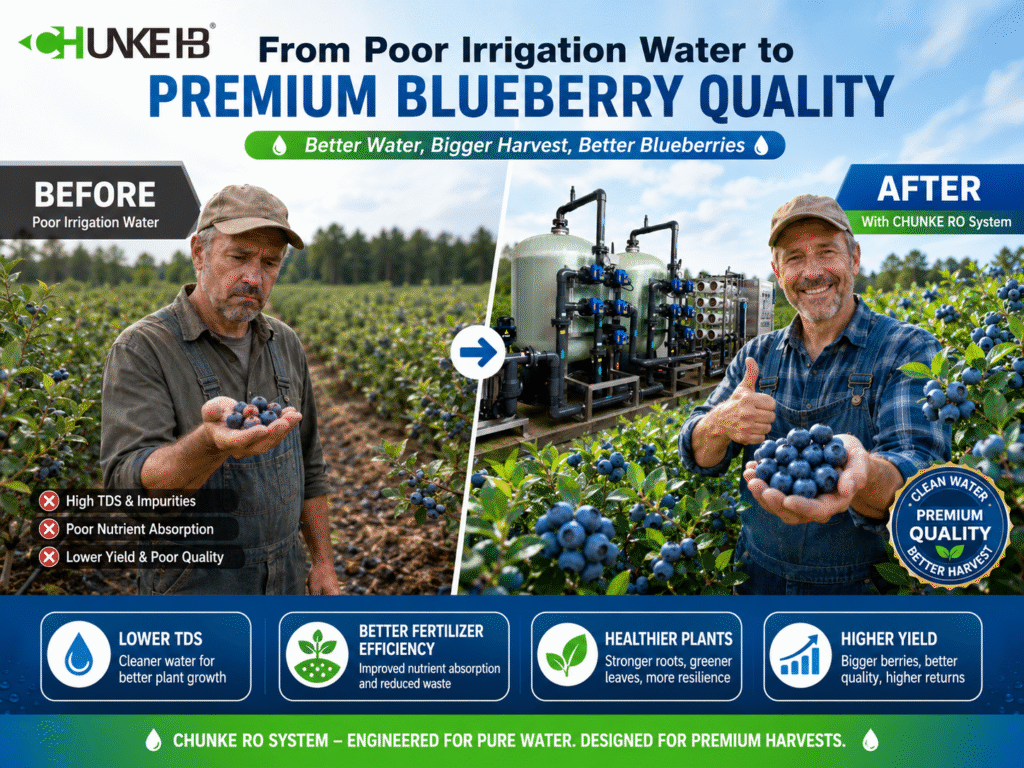
Common Water Sources and Their Typical TDS Problems by Region
Blueberry cultivation has expanded rapidly into regions where source water quality is far from ideal, which is exactly where irrigation water treatment becomes a production necessity rather than an optional upgrade.
In much of the Middle East and North Africa, groundwater is frequently brackish, with TDS readings well above 1,500 ppm and elevated chloride and boron. Farms in these regions almost always require reverse osmosis pretreatment before the water ever reaches a drip line. Across parts of the CIS region, mineral-rich aquifer water often carries high bicarbonate and sulfate content, which pushes soil pH in the wrong direction for an acid-loving crop like blueberry even when raw TDS numbers look moderate.
In Southeast Asia, surface water and shallow wells can vary dramatically by season, running relatively clean during monsoon months and spiking in TDS during dry season as aquifers concentrate. African blueberry projects, increasingly common in export-oriented horticulture zones, frequently combine both challenges: seasonal variability plus naturally saline groundwater. South American growers expanding blueberry acreage into new valleys face similar issues, particularly where irrigation water is shared with other agriculture and carries agricultural runoff salts.
Across all of these markets, the underlying lesson is the same: a full water test before planting, repeated at least seasonally afterward, is the only reliable way to know whether your irrigation water needs treatment, and how much.
How Reverse Osmosis Solves Blueberry Irrigation Water Problems
Reverse osmosis, or RO, remains the most reliable technology for bringing high-TDS irrigation water down into the safe range for blueberries. RO works by forcing source water through a semi-permeable membrane under pressure, rejecting the vast majority of dissolved salts, boron, chloride, and sodium while producing a clean permeate stream suitable for fertigation.
Our team at Chunke Water Treatment designs RO systems specifically for agricultural fertigation clients, which differs meaningfully from municipal or industrial RO design. Farm systems need to handle seasonal flow variation, tolerate biofouling from surface water sources, and integrate cleanly with existing drip infrastructure and fertigation tanks.
Blending Permeate to Hit the Right EC, Not Zero
A common misconception is that lower TDS is always better. In reality, blueberries still need some baseline mineral content in irrigation water, and RO permeate alone can run below 10 ppm TDS, which is unnecessarily pure and wastes both membrane life and energy. The better approach is blending RO permeate with a controlled percentage of raw source water to land precisely at the target EC for your fertigation program, typically in that 100 to 250 ppm pre-fertigation range discussed above.
This blending strategy is built directly into the system design, using automated blending valves and inline conductivity sensors so the ratio adjusts automatically as source water quality shifts season to season. It is a far more cost-efficient approach than running 100 percent permeate through the entire irrigation program.
Core Components in an Agricultural RO System
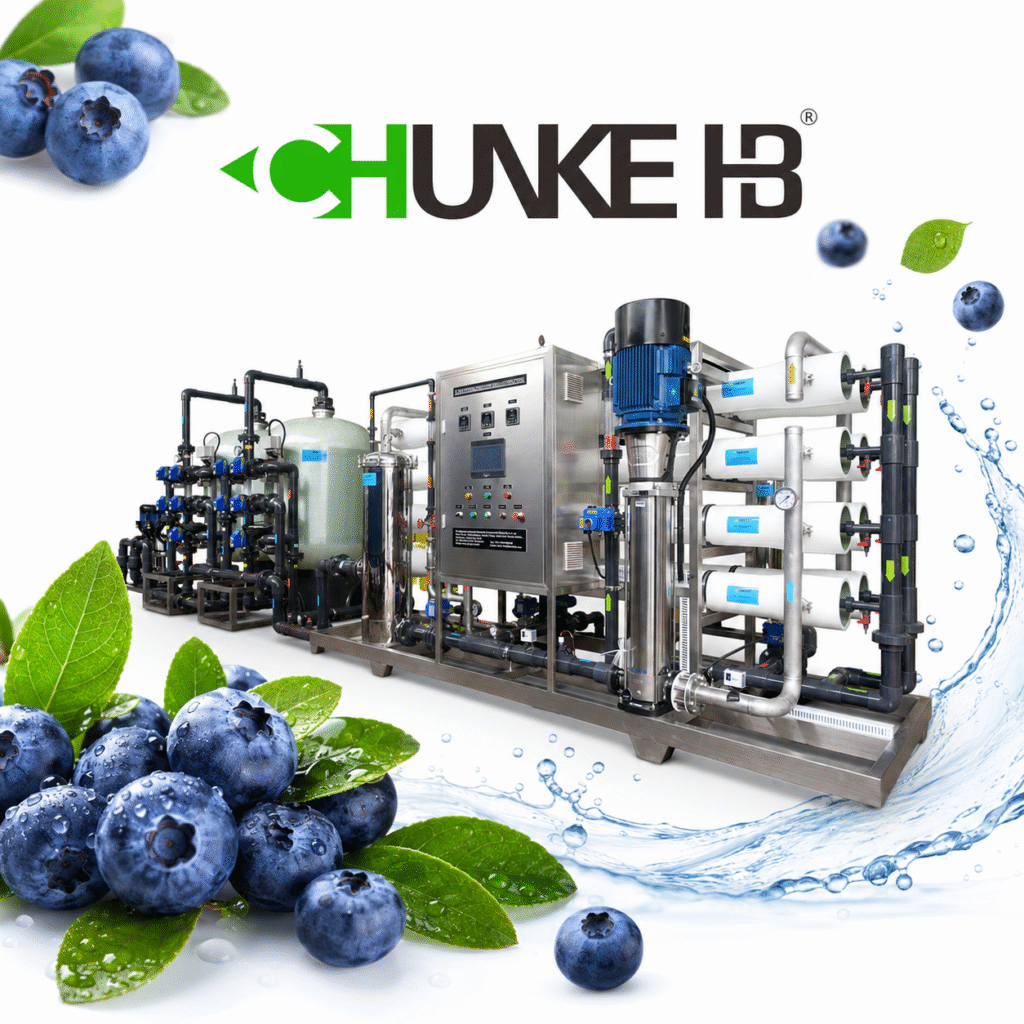
A well-built RO system for blueberry irrigation typically includes reverse osmosis membranes from suppliers such as Toray, DuPont, Hydranautics, or Vontron, housed in pressure vessels such as those from ROPV. High-pressure feed pumps are commonly sourced from Grundfos or CNP, while variable frequency drives from Danfoss keep pump energy consumption matched to actual flow demand rather than running at fixed speed all day.
Automation and monitoring typically run through a Siemens or Schneider Electric PLC and HMI panel, with inline conductivity, pH, and pressure sensors from Endress+Hauser feeding real-time data back to the blending control loop. Piping and valve systems from +GF+ round out a corrosion-resistant fluid path suitable for years of continuous farm use.
Designing an RO System Sized to Your Blueberry Farm
Sizing an RO system correctly starts with three numbers: total planted hectares, peak daily irrigation demand during fruiting, and raw water TDS. Undersizing a system forces growers to run pumps continuously at peak season with no reserve capacity, while oversizing wastes capital on membranes and vessels that sit idle most of the year.
For growers scaling up quickly or planting in phases, a containerized RO system offers a practical middle path. Built and tested inside a standard shipping container, the entire treatment train arrives ready to connect to power, feed water, and the irrigation mainline, cutting installation time from months to weeks. This matters considerably for growers on tight planting schedules tied to a specific growing season.
Larger estates with permanent infrastructure often prefer a skid-mounted or building-housed system sized for long-term expansion, with extra membrane housing slots built in from day one so capacity can grow as new blocks come into production. Either configuration should be paired with pretreatment, typically multimedia filtration and cartridge filters ahead of the membranes, to protect against the sediment and organic loading common in agricultural surface water and shallow well sources.
Our engineering team reviews water analysis reports directly and proposes a system spec matched to your specific TDS, boron, and chloride numbers rather than a generic template. You can see examples of completed agricultural desalination projects, including seawater and brackish groundwater applications, on our sister site SWRO Plant.
Monitoring and Maintaining Water Quality Season to Season
Treating water once at the start of a planting cycle is not enough. Source water quality shifts with rainfall, aquifer drawdown, and seasonal agricultural activity nearby, so ongoing monitoring should be built into the farm’s standard operating routine.
Most commercial operations test raw and treated water TDS, EC, and pH at least monthly, with a full laboratory analysis covering boron, chloride, sodium, and bicarbonate once or twice a year. Inline sensors integrated into the RO control panel provide continuous readings between lab tests, alerting the farm manager immediately if conductivity drifts outside the target blending range.
Membrane maintenance also plays a direct role in water quality consistency. Fouled or scaled membranes reject salts less effectively over time, gradually letting more TDS through into what growers assume is still “treated” water. A cleaning-in-place schedule, informed by pressure differential readings across the membrane stack, keeps rejection rates consistent throughout the season rather than degrading silently until fruit quality problems appear.
Working With a Manufacturer That Understands Both Water and Agriculture
Choosing the right water treatment for blueberry irrigation is ultimately a systems decision, not just a membrane purchase. It requires understanding blueberry-specific tolerance thresholds, seasonal source water variability, fertigation chemistry, and the practical realities of running equipment on a working farm rather than in a controlled industrial plant.
At Chunke Water Treatment, we design and manufacture RO, UF, and containerized water treatment systems specifically for exporters and growers supplying international markets across the Middle East, Southeast Asia, Africa, the CIS, and South America. Every system is engineered around your actual water analysis, your farm’s fertigation program, and your production timeline, not a one-size-fits-all package.
If you are planning a new blueberry planting or struggling with inconsistent yields on an existing farm, the first step is a water test. From there, our team can recommend the right RO configuration, blending strategy, and component specification to bring your irrigation water reliably within blueberry’s safe range, season after season. Fill in the contact form on our contact page, and our team will reach out to review your water analysis and farm requirements directly.
— David