
Industrial water treatment systems for EPC contractors need to fit the process design, the site layout and the project schedule. Whether you are preparing a bid for a factory utility plant, a desalination project or a high-purity water system, the first step is to define what the package must deliver and how it connects to the rest of the plant.
Guangzhou Chunke Environmental Technology Co., Ltd. designs and manufactures water treatment equipment packages. Depending on the project, a package can include pretreatment, reverse osmosis (RO), ultrafiltration (UF), electrodeionization (EDI), chemical dosing and controls. This guide explains how EPC teams can specify those systems, compare proposals on the same basis and plan a practical factory acceptance test.
Start with the water the plant needs
Set the design basis before selecting the membrane train. Start with the water required at the point of use. A boiler make-up system, a production rinse line and a general utility header can each need different water quality. List the parameters that matter, their limits and the sampling point. For example, specify conductivity at a stated reference temperature and identify where the acceptance sample will be taken.
Next, confirm whether the capacity is hourly product flow or daily production. A plant that needs 600 m³ per day in a 20-hour operating window needs 30 m³/h of net production during the available hours. If filter backwash, membrane flushing or cleaning must happen within that window, allow for the lost time or confirm that storage can cover the interruption. State whether the process must maintain full output when one train is down.
In addition, share the latest feed-water analysis and any seasonal records. Include source, temperature, pH, conductivity or TDS, hardness, alkalinity, silica, iron, manganese, turbidity and any oxidant residual. A seawater intake or wastewater reuse project may require additional testing to describe its variability. If the available data represent a single sample, identify that gap in the RFQ and agree how the vendor will handle it during detailed design.

Choose industrial water treatment systems for EPC contractors by feed source
Brackish groundwater and industrial make-up water
For a brackish well, start with the full analysis and the expected range of water levels or supply pressures. Groundwater may need iron or manganese removal ahead of the membrane system. The scaling assessment should consider the dissolved salts, proposed recovery, temperature and pH. Use it to confirm where chemical dosing or other pretreatment belongs. Then use the membrane projection to specify product quality across the agreed feed range. See Chunke’s brackish water RO systems and its published industrial RO project in Tunisia.
Seawater desalination
For a seawater project, define the intake type and share the expected salinity and temperature range. Discuss the effect of intake conditions on pretreatment, and identify who is responsible for the intake works and concentrate discharge. Ask the supplier to show the seawater RO operating points, the proposed high-pressure pump duty and any energy recovery option. Confirm which pumps and other loads the supplier includes when reporting energy consumption. See Chunke’s seawater RO systems.
Surface water pretreatment and high-purity process water
Surface water with changing turbidity may call for a pretreatment step such as UF, depending on the feed characteristics and operating conditions. Ask for the backwash sequence, backwash water demand and waste flows. When the final use requires high-purity water, assess whether a second RO pass, degassing or EDI is appropriate. An EDI unit needs feed water within its specified limits. Ask the supplier to confirm those limits and explain how the upstream stages will meet them. Explore Chunke’s ultrafiltration systems and EDI equipment.
Review the water balance and the duty points
Ask for a water balance that starts at the package inlet and ends at each outlet. For example, an RO stage producing 30 m³/h at an assumed 75% stage recovery needs 40 m³/h of RO feed and produces 10 m³/h of concentrate. The calculation is 30 ÷ 0.75. This is a brackish RO illustration. The actual design recovery comes from the agreed feed analysis and membrane projection.
In practice, the raw-water supply may need to provide more than 40 m³/h in that example. Account for filter backwash, any separate rinse demand and the effect of intermittent operation. Ask the bidder to distinguish RO stage recovery from whole-package recovery. If a recycle stream is proposed, have the supplier identify its destination and flow so that everyone uses the same boundary when comparing figures.
Next, record minimum, normal and maximum flow for each operating case. Check what happens if the upstream supply falls below package demand. The design may need a buffer tank, feed pump control or a low-flow shutdown. If the EPC team provides storage, ask the package vendor to state how it uses the tank level and which signals the two systems exchange. This makes the controls review much more concrete.
Define the scope of industrial water treatment systems for EPC contractors
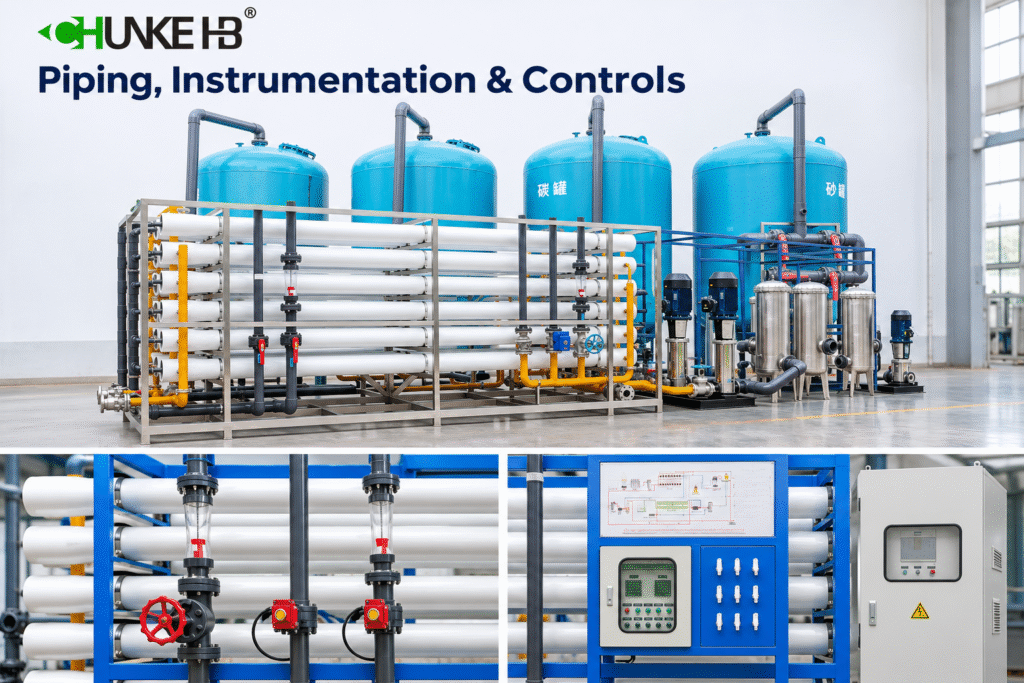
Put the package boundaries in the RFQ and confirm them on the piping and instrumentation diagram (P&ID). For each tie-in, list the responsible party, fluid, normal and design conditions, materials and connection standard. A scope table like the one below makes exclusions visible before anyone compares prices.
| Interface | Confirm with the package supplier | Confirm with the EPC team |
|---|---|---|
| Raw-water inlet | Required flow, pressure range and connection | Feed source, upstream piping and available supply |
| Product water | Flow, quality and outlet connection | Storage, distribution and point of use |
| Concentrate and drains | Peak flows, characteristics and drain connections | Collection, routing and disposal destination |
| Electrical and controls | Connected load, panel and signal list | Incoming power, field cabling and plant controls |
| Documentation and testing | Drawings, FAT scope and handover records | Review milestones, witness points and site tests |
Also reserve access to remove membranes, service pumps, refill chemical tanks and reach the control panel. Check maintenance clearances against the plant layout and the available lifting route. If weather exposure or site work is a concern, compare a skid installed in an existing building with a containerized RO package. For the container option, agree who supplies ventilation, heat control, power and field connections.
Specify pumps, membranes and controls by duty
An approved vendor list helps procurement, but the offer still needs a model and a duty point. Ask bidders to state the proposed model, its function and the selection basis. If the project allows equivalents, request a written comparison covering performance, materials, dimensions and the effect on spares. Treat the manufacturers below as references for component selection. Final choices depend on the project specifications and the approved equipment list.
- Danfoss pumps. For a suitable seawater RO duty, review the Danfoss APP high-pressure pump range. Confirm flow, pressure, allowable inlet conditions and how the pump interfaces with the high-pressure circuit.
- Grundfos pumps. Review the Grundfos CR, CRI and CRN pump data booklet for applicable multistage duties. Compare the curve, materials, seal and suction requirements at each operating point.
- DuPont RO membranes. Use the DuPont FilmTec RO membrane range alongside the proposed element datasheet and design projection.
- Toray RO membranes. Consult the Toray membrane product range. Ask the bidder to identify the exact element and document its predicted performance under the same feed conditions used for other offers.
- Siemens PLC. For projects that specify Siemens automation, review the SIMATIC S7-1500 PLC range. Define the I/O count, communications and handover requirements for the software.
- ABB drives. Review the ABB ACS580 variable-frequency drive range where specified. Confirm motor current, enclosure, cooling, site ambient conditions and any project requirements for harmonics or communications.
Membrane projections and utility schedules
For every RO proposal, ask for the projection summary with feed assumptions, stage arrangement, recovery, pressure and estimated permeate quality. Request a motor list and a utility schedule as well. A brand list is useful for procurement. However, the duty points and design documents tell the engineering team what will actually be installed.
Test industrial water treatment systems for EPC contractors before handover
Agree who controls the raw-water feed valve, inlet pump and product-water tank connection. If the site supplies a run permissive, define what the PLC does when the signal drops out. Also specify the required response to low suction pressure, elevated filter differential pressure and high permeate conductivity. Where the design diverts off-spec water, show the diversion route and confirm where the signal is measured.
Next, share the site communications standard and request a draft I/O list before panel design. Record the tags, engineering units, alarm priorities and handshakes that the facility needs. For example, identify which flow and conductivity values will go to the central control room. Also clarify who supplies the network switch, cables and final connection. These decisions affect the panel design and the checks that can be completed at the factory.
Define the factory acceptance test (FAT) and site acceptance test (SAT) during procurement. The FAT may include a visual inspection, tag and wiring checks, a leak or pressure test where specified, and demonstrations of alarms and sequences. State which events require buyer witnessing and how the team will record and close any findings.
If the factory test water differs from the design feed, agree which guarantees will be demonstrated at site. The SAT protocol should state feed conditions, sampling points, stabilization period, instruments and acceptance limits. For an energy target, define which electrical loads are included and how power and product flow will be measured over the same test period.

Align the document register with the build schedule
Ask for a document register with issue dates and review milestones. A package may need a process flow diagram, P&ID, general arrangement drawing, utility and tie-in list, instrumentation list, electrical schematics, control narrative and operating manual. Add material certificates, welding records, inspection records or other project-specific documents where the specification calls for them. Define which documents are for approval and which are for information.
Meanwhile, agree on the review turnaround and the point when drawings can be released for manufacture. If client comments change the package after approval, record the effect on price, procurement or delivery before releasing revised drawings. At handover, request the agreed as-built files, FAT records and a recommended spares list. For the site team, also identify which activities require the vendor’s support during startup and which are performed by the EPC contractor.
Shipping, maintenance and open items
Before releasing the purchase order, compare the current bid with the latest site layout and equipment schedule. In particular, confirm the maximum shipping dimensions, the heaviest lift and any items that must ship loose. Ask for the package footprint and operating weight, along with the locations of lifting points and anchor bolts. If the plant room already exists, share the doorway and access route so the vendor can identify any assembly required on site.
As part of the bid review, ask how the offer handles chemical use, replacement consumables and planned maintenance. For example, a package can include a cleaning-in-place system on the same skid or share a central cleaning system with another train. As a result, the selected arrangement changes the connection list and the way operators schedule service. Ask which cartridge filters, membrane elements and instruments are expected to be stocked by the owner and which spare parts the offer includes.
Finally, agree how the vendor will record exceptions to the owner’s specifications. A simple register can show the requirement, the proposed departure and its impact on the design or supply scope. Use the same approach for open items such as feed quality or site power. Finally, assign an owner and a closing date to each item so procurement can see which assumptions must be resolved before manufacture.
See the equipment before reviewing an RFQ
A workshop or project video can show how operators reach the membrane vessels, instruments and panel. Use it alongside the general arrangement drawing when checking access and the location of connections.
Request a quote for industrial water treatment systems for EPC contractors
A good RFQ gives suppliers enough information to price the same scope. Send the feed-water data and target product-water specification, even if the project is at the budget stage. If a value is provisional, label it and ask bidders to state the assumption they used. This makes it easier to update the quotation once the owner confirms the design basis.
- Feed source and water analysis. Include sampling dates, expected seasonal conditions, available flow, supply pressure and temperature range.
- Product-water requirement. State net capacity, operating hours, quality limits at each point of use and any availability or standby requirement.
- Site and utilities. Provide the country, electrical supply, indoor or outdoor location, space limits, drainage and available services.
- Scope and specifications. Identify the package tie-ins, approved brands, piping materials, applicable project standards and work supplied by others.
- Acceptance and delivery. Share the document list, witness points, target shipment date, packing requirements and intended commissioning scope.
Finally, ask for a compliance and deviations list with every offer. Then compare the guaranteed capacity and quality, feed conditions, package boundaries and acceptance tests side by side. An offer that excludes pretreatment backwash, field cabling or site testing may need additional EPC scope before it is comparable. Capture those differences while procurement can still clarify them.
Frequently asked questions from EPC teams
Can one package combine pretreatment, RO and EDI?
Yes, if those stages fit the feed source and the final water specification. For example, a combined package can include the interstage instruments and controls needed for coordinated operation. Share the feed-water report and end-use requirements so the supplier can confirm the right stages and identify any equipment that needs a separate location.
What if the feed-water analysis is incomplete at bid stage?
Request a budget proposal using a stated design basis. Identify the missing parameters and set a sampling deadline before final selection. Ask the supplier which price or performance items depend on the missing data. That lets the project team compare budget offers while keeping the design assumptions visible.
Can an EPC contractor request an approved component brand?
Yes. Include the preferred make, model restrictions and the owner’s rules for equivalents. Ask the supplier to mark each deviation and give the reason. Where a particular model is mandatory, flag it early enough to confirm availability and lead time.
Discuss your EPC water treatment project with Chunke
Chunke supplies industrial water treatment systems for EPC contractors. Share your project location, feed-water report, required capacity and product quality. If you already have a datasheet, P&ID or technical specification, mention it in your message so the team can arrange how to review it with you. Contact Chunke to discuss your water treatment RFQ.