
UF vs RO is one of the first questions every plant engineer, project contractor, and procurement manager asks when planning a new water treatment system. Both technologies use membranes, both look similar on a skid, and both promise clean water. However, they remove very different contaminants, run at very different pressures, and cost very different amounts to operate.
Choose the wrong one, and you either overspend on a system you do not need or end up with water that still fails your specification. In this guide, we compare ultrafiltration (UF) and reverse osmosis (RO) side by side, with real operating figures, so you can decide with confidence.
At Chunke Water Treatment, we design and export both UF and RO systems from Guangzhou to clients across the Middle East, Southeast Asia, Africa, the CIS, and South America. Therefore, this article draws on practical project experience, not just textbook theory.
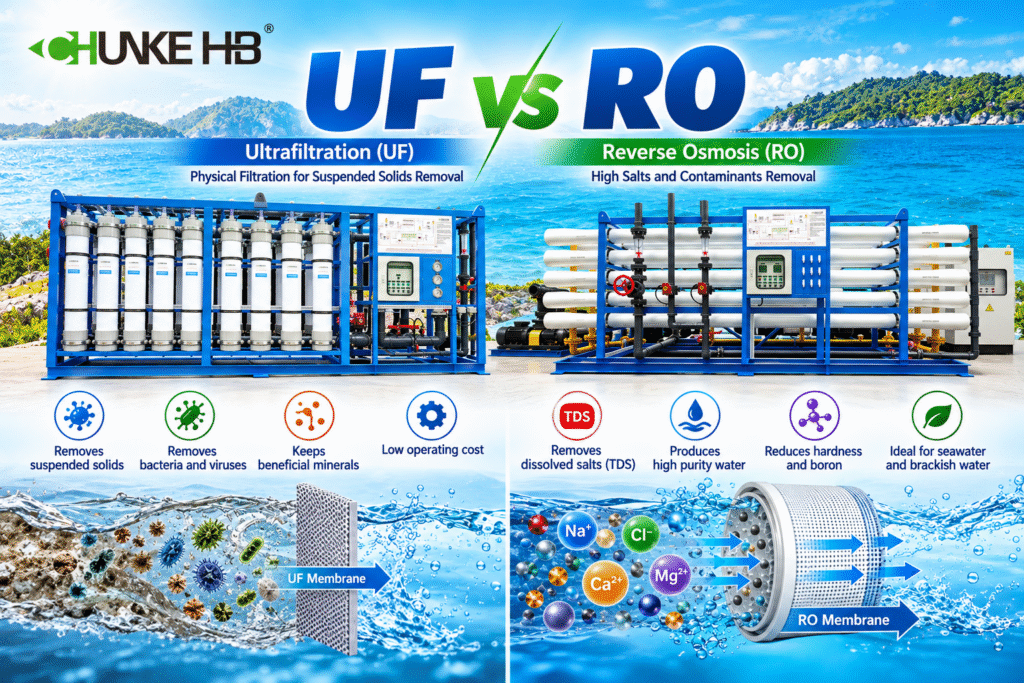
UF vs RO at a Glance: The Short Answer
Here is the core UF vs RO difference in one sentence: UF removes particles, bacteria, and viruses but lets dissolved salts pass, while RO removes almost everything, including dissolved salts. In other words, UF clarifies and disinfects water, whereas RO desalinates and purifies it.
The UF vs RO table below summarizes the typical operating ranges we see on industrial projects.
| Parameter | Ultrafiltration (UF) | Reverse Osmosis (RO) |
|---|---|---|
| Pore size / cut-off | 0.01–0.1 µm (approx. 50–150 kDa) | ~0.0001 µm (non-porous, diffusion) |
| Removes dissolved salts (TDS) | No | Yes, 98–99.7% rejection |
| Removes bacteria and viruses | Yes, typically 4–6 log bacteria, 2–4 log viruses | Yes |
| Operating pressure | 0.5–3 bar | 8–20 bar (brackish), 55–70 bar (seawater) |
| Water recovery | 90–95% | 70–80% (brackish), 40–45% (seawater) |
| Energy use | 0.05–0.2 kWh/m³ | 0.5–1.5 kWh/m³ (brackish), 2.8–3.5 kWh/m³ (seawater with ERD) |
| Typical product quality | Turbidity <0.1 NTU, SDI15 <3 | TDS often <10–300 mg/L depending on feed |
| Membrane life | 5–8 years | 3–5 years |
| Main role | Clarification, disinfection, RO pretreatment | Desalination, purification, process water |
What Is Ultrafiltration (UF)?
Ultrafiltration is a low-pressure membrane process that physically sieves water through hollow fibers with extremely fine pores. Most industrial UF modules use PVDF or PES hollow fibers, which offer high strength and good chlorine tolerance. As a result, UF can handle variable surface water, well water, and treated wastewater with stable performance.
If you want a deeper technical walkthrough, our guide on the ultrafiltration system for water treatment and its key specs explains module types, flux design, and cleaning regimes in detail.
How a UF System Works
Feed water first passes through a self-cleaning screen filter, usually 100–200 µm, to protect the fibers. Next, a feed pump pushes water through the hollow fibers at low pressure, either inside-out or outside-in. Clean filtrate collects on the other side of the membrane, while solids stay behind.
Because solids build up on the fiber surface, the system runs short filtration cycles of 20–60 minutes. After each cycle, it reverses flow for a backwash of 30–60 seconds. In addition, a chemically enhanced backwash (CEB) with sodium hypochlorite, acid, or caustic runs daily or weekly to keep the transmembrane pressure under control.
What UF Removes — and What It Leaves Behind
UF reliably removes:
- Suspended solids, silt, and colloids
- Turbidity, typically down to <0.1 NTU
- Bacteria, cysts, and most viruses
- High-molecular-weight organics and some color
- Oil emulsions in certain industrial streams
On the other hand, UF does not remove dissolved salts, hardness, nitrate, fluoride, arsenic, or small organic molecules. Consequently, if your raw water has high TDS, UF alone will not make it drinkable or usable as boiler feed.
What Is Reverse Osmosis (RO)?
Reverse osmosis forces water through a semi-permeable polyamide membrane at a pressure higher than the natural osmotic pressure of the feed. Water molecules pass through, whereas dissolved ions, salts, and small organics stay in the concentrate stream. Thus, RO is the standard technology for desalination and high-purity water.
Leading membrane makers such as Toray, DuPont FilmTec, and Hydranautics supply spiral-wound elements in 4-inch and 8-inch sizes, and we select the right model for each feed water analysis.
How an RO System Works
A typical RO train includes a cartridge filter (usually 5 µm), antiscalant dosing, a high-pressure pump, membrane pressure vessels, and a CIP cleaning skid. The high-pressure pump delivers water to the vessels, where spiral-wound elements split it into permeate and concentrate. Meanwhile, the PLC monitors pressure, flow, and conductivity to protect the membranes.
For a full view of our configurations, see our RO membrane systems for commercial and industrial use.
Brackish Water RO vs Seawater RO
RO comes in two main families. Brackish water RO (BWRO) treats feed up to about 10,000 mg/L TDS at 8–20 bar. Seawater RO (SWRO), by contrast, treats 35,000–45,000 mg/L TDS at 55–70 bar and needs duplex or super duplex stainless steel high-pressure piping plus an energy recovery device.
If your project draws from the sea, our dedicated seawater reverse osmosis (SWRO) systems page covers design, materials, and energy recovery. You can also explore containerized and island desalination projects on our sister site, swro-plant.com.
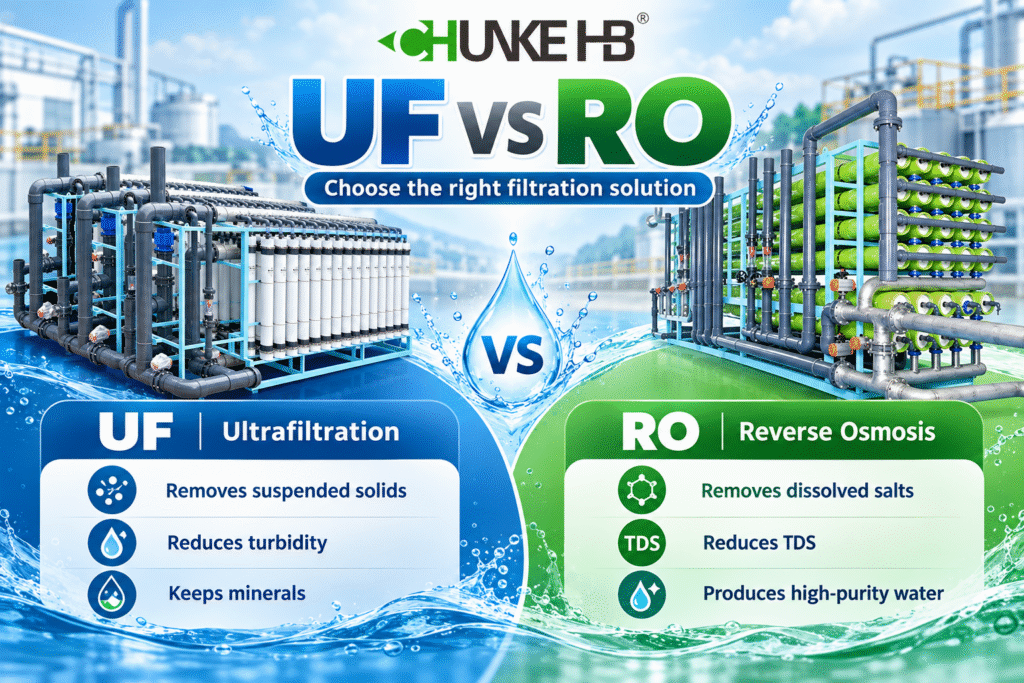
UF vs RO: 7 Key Differences Explained
Now let us look closer at the seven UF vs RO differences that matter most when you write a specification or compare quotations.
1. Separation Mechanism and Pore Size
UF works like an ultra-fine sieve: anything larger than the pore size stays out. RO, however, has no real pores in the classic sense. Instead, water diffuses through the dense polyamide layer, while ions are rejected. This is why RO can remove sodium and chloride, but UF cannot.
2. Operating Pressure and Energy
UF runs at 0.5–3 bar, so standard centrifugal pumps handle the job with very low power. In contrast, RO needs a multistage high-pressure pump from suppliers such as Grundfos or CNP, and SWRO often uses Danfoss APP axial piston pumps combined with isobaric energy recovery. Therefore, RO energy per cubic meter is roughly 5 to 30 times higher than UF.
3. Water Recovery
A well-designed UF plant recovers 90–95% of the feed, because it only rejects a small backwash stream. RO, on the other hand, must reject a concentrated brine. Brackish systems typically reach 70–80% recovery, while seawater systems stay around 40–45%. As a result, RO needs more raw water intake and a plan for concentrate disposal.
4. Product Water Quality
UF filtrate is clear and microbiologically safe, yet its TDS stays the same as the feed. RO permeate, by comparison, typically has 98–99.7% lower TDS. For example, a 2,000 mg/L brackish well becomes 20–60 mg/L permeate after a single RO pass. When even higher purity is needed, a second RO pass or RO with electrodeionization (EDI) can deliver ultrapure water.
5. Fouling and Cleaning
UF is designed to handle solids. It backwashes automatically every cycle and tolerates turbidity spikes well. RO membranes, however, cannot be backwashed, so they foul if suspended solids, organics, or scale reach them. For this reason, RO depends on good pretreatment, antiscalant dosing, and periodic CIP. Our article on fouling and scaling on membrane filtration explains the warning signs to watch.
6. Membrane Life and Operating Cost
Robust PVDF UF fibers often last 5–8 years, whereas RO elements usually last 3–5 years, depending on pretreatment quality. In addition, RO consumes antiscalant, cleaning chemicals, cartridge filters, and more power. Consequently, in any UF vs RO cost comparison, operating cost per cubic meter is clearly lower for UF.
7. Footprint and Capital Cost
For the same flow, UF skids are generally simpler and cheaper, since they use low-pressure PVC-U or ABS piping. RO needs stainless steel high-pressure piping, larger pumps, and more instrumentation. Nevertheless, comparing price alone is misleading, because the two systems do different jobs. The real question is which water quality your process needs.
When UF Alone Is the Right Choice
UF alone is the smart and economical choice when your raw water TDS is already acceptable, but turbidity, bacteria, or suspended solids are the problem. Typical examples include:
- Drinking water from rivers, lakes, or reservoirs with low salinity
- Rural and emergency water supply where pathogens are the main risk
- Cooling tower make-up and general process water
- Swimming pool and aquaculture water polishing
- Tertiary treatment of municipal wastewater for irrigation reuse
For these applications, our industrial ultrafiltration UF systems provide stable filtrate quality with minimal chemicals and very low energy.
When You Need RO
On the contrary, you need RO whenever dissolved contaminants exceed your limit. Choose RO when:
- Feed TDS is above 500–1,000 mg/L and you need potable water
- You treat seawater or brackish groundwater
- Boiler feed, pharmaceutical, or electronics water requires low conductivity
- You must remove fluoride, nitrate, arsenic, hardness, or heavy metals
- Food and beverage production needs a consistent, low-mineral base water
In these cases, our industrial reverse osmosis systems deliver the required permeate quality, with designs verified by membrane projection software for every feed analysis.
UF vs RO Is Often the Wrong Question: Why UF + RO Works Better Together
In many industrial projects, the best answer to UF vs RO is actually “both.” UF makes an excellent pretreatment step for RO, because it delivers feed water with SDI15 consistently below 3 and turbidity below 0.1 NTU. Conventional multimedia filters, by contrast, often struggle to stay below SDI 5 when raw water quality changes.
Adding UF ahead of RO brings clear, measurable benefits:
- Fewer RO cleanings — CIP frequency often drops from monthly to quarterly or longer
- Longer RO membrane life, which lowers replacement cost
- Higher RO design flux, so fewer elements and vessels are needed
- Stable operation during algae blooms, storms, and turbidity spikes
- Smaller footprint than multimedia plus coagulation and settling
This UF + RO combination is especially valuable for seawater intakes, surface water, and wastewater reuse. In fact, many of our seawater and reuse projects now use a UF–RO design as standard. For remote sites, we also build containerized ultrafiltration systems that pair with containerized RO for fast plug-and-play installation.
Typical UF and RO Applications by Industry
To make the UF vs RO choice easier, here is how we usually match technology to industry:
| Industry / Application | Recommended Technology | Why |
|---|---|---|
| Municipal drinking water (fresh source) | UF | Removes pathogens and turbidity; TDS already acceptable |
| Brackish well water for drinking | Media filter + RO or UF + RO | TDS, hardness, and fluoride must be reduced |
| Seawater desalination (hotels, islands, ports) | UF + SWRO | Stable SDI protects high-value SWRO membranes |
| Boiler feed water | RO or RO + EDI | Low conductivity protects boilers from scale |
| Food and beverage | UF + RO | Consistent taste and microbiological safety |
| Industrial wastewater reuse | UF/MBR + RO | UF removes solids; RO removes salts for reuse |
| Mining and process water | UF + RO | Handles high solids and dissolved metals |
| Cooling tower make-up | UF (sometimes + RO) | Reduces solids and biofouling at low cost |
How to Choose Between UF vs RO: A 5-Step Decision Guide
Before you settle the UF vs RO question or request a quotation, follow these five steps. They save time and help any supplier design the right system the first time.
- Get a full water analysis. At minimum, test TDS, conductivity, pH, turbidity, SDI, hardness, iron, manganese, silica, TOC, and bacteria.
- Define the product water specification. For example, WHO drinking water guidelines, boiler feed limits, or your process requirement.
- Compare feed and target. If only particles and microbes exceed the limit, UF may be enough. If dissolved salts exceed it, you need RO.
- Check feed variability. Surface water, seawater, and wastewater change seasonally, so UF pretreatment usually pays back before RO.
- Calculate lifecycle cost. Include energy, chemicals, membrane replacement, labor, and concentrate disposal over 10 years, not just purchase price.
If you are unsure at any step, send us your water analysis. Our engineers will run a membrane projection and recommend UF, RO, or a combined design.
Key Components That Decide Long-Term Performance
Two systems can share the same capacity on paper and still perform very differently after two years. The difference usually lies in the components. Therefore, we build every Chunke system with proven international brands:
- Membranes: UF modules and RO elements from Toray, DuPont, Hydranautics, LG Chem, or Vontron, chosen per project
- Pressure vessels: FRP housings from ROPV rated for brackish or seawater pressure
- Pumps: Grundfos, CNP, and Danfoss high-pressure pumps
- Piping and valves: +GF+ PVC-U and ABS systems on the low-pressure side
- Instruments: Endress+Hauser flow, pressure, and conductivity measurement
- Controls: Siemens PLC and HMI, plus Schneider Electric electrical components and VFDs
Because of this component strategy, our clients get reliable spare part supply in their own country and a system their local technicians already understand.
📷 PHOTO 3 — insert below (suggested: finished UF + RO system / containerized plant ready for shipment)
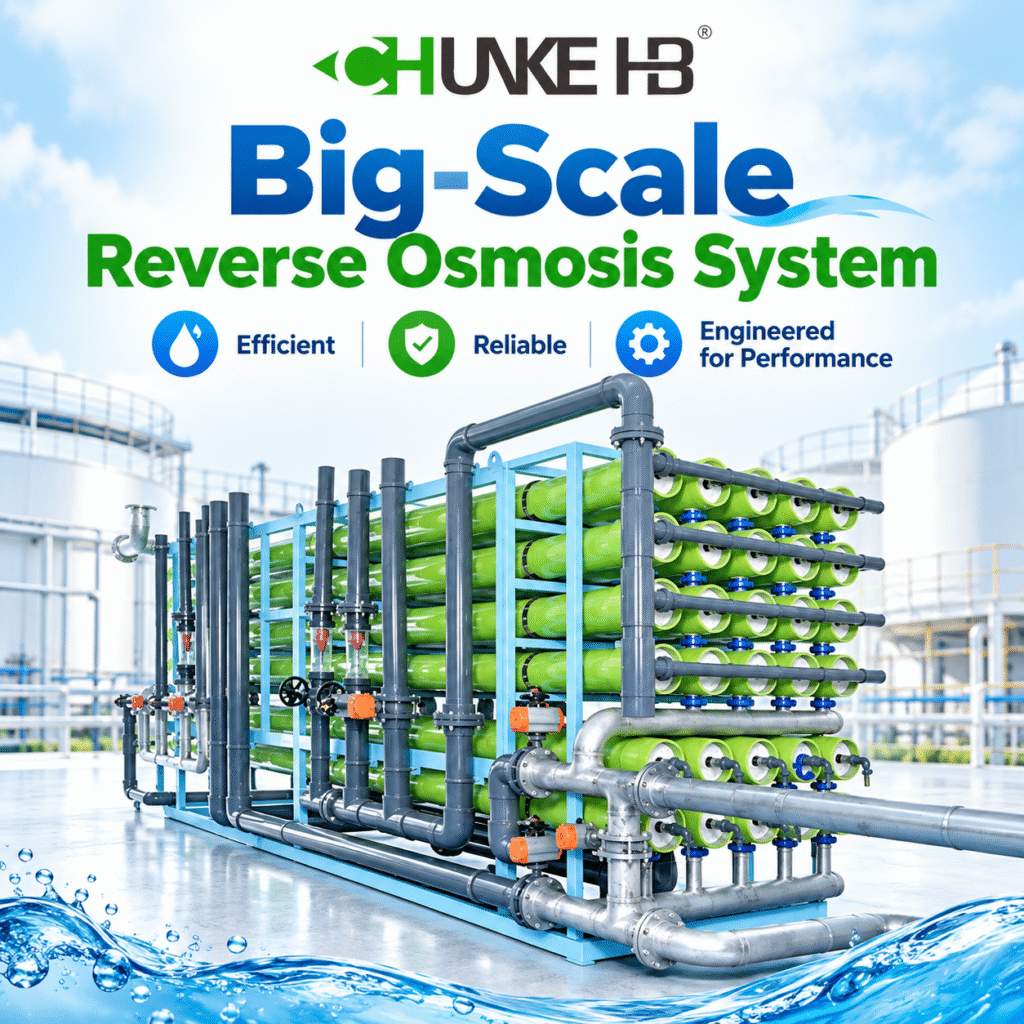
Chunke UF and RO Systems: Engineered, Not Just Assembled
Chunke Water Treatment is a system-driven manufacturer, not a box supplier. Every project starts with your water analysis and ends with a system tested in our factory before shipment. Specifically, we offer:
- UF systems for clarification, disinfection, and RO pretreatment, from compact skids to large multi-train plants
- Brackish water RO for wells, rivers, and industrial process water
- Seawater RO (SWRO) with energy recovery for hotels, islands, ports, and industry
- Integrated UF + RO + EDI trains for boiler feed and ultrapure water
- Containerized UF and RO plants for remote sites, mining camps, and fast deployment
In addition, we provide membrane projections, P&ID drawings, factory acceptance testing, installation guidance, operator training, and long-term spare parts support. You can browse our full range of water treatment systems to see standard capacities and configurations.
Conclusion: Making the Right UF vs RO Decision
To sum up, the UF vs RO choice comes down to one question: what is in your water, and what must come out? UF is the efficient answer for particles, turbidity, and pathogens. RO is the necessary answer for salts and dissolved contaminants. Moreover, for seawater, surface water, and wastewater, UF + RO together usually gives the lowest lifecycle cost and the most stable operation.
Do not leave this decision to a generic price list. Instead, let our engineers review your water analysis and design a system that fits your capacity, budget, and local conditions.
Ready to find the right system for your project? Fill in our contact form with your water analysis, required capacity, and site location. Our engineering team will reach out with a tailored UF, RO, or UF + RO proposal.
— David, Chunke Water Treatment