
A brackish water reverse osmosis system is the most cost-effective way to turn salty well, borehole, or inland surface water into clean, usable supply for industry, agriculture, and municipalities. Across the Middle East, Africa, Southeast Asia, the CIS, and South America, fresh water is scarce, yet brackish sources with 1,000 to 15,000 mg/L of dissolved salts sit almost everywhere underground. Therefore, treating that water on site is far smarter than trucking it in or drilling deeper. In this guide, David from Chunke Water Treatment walks you through how the technology works, how to size it, what it costs, and how to choose the right supplier.
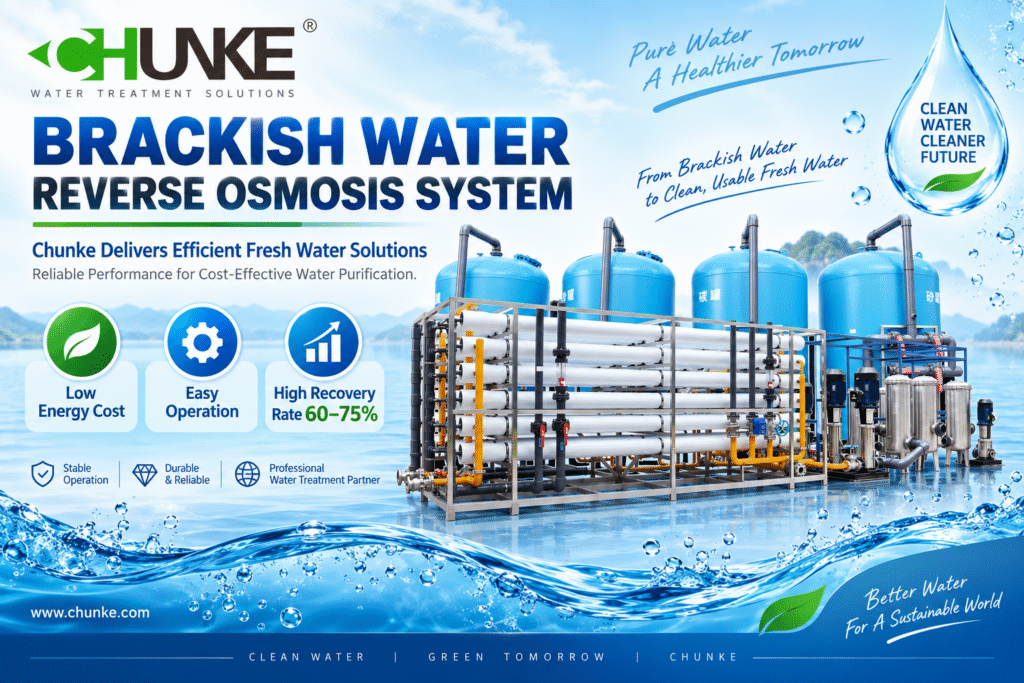
What Is a Brackish Water Reverse Osmosis System?
A brackish water reverse osmosis system is a membrane-based treatment plant that pushes brackish feed water through semi-permeable RO membranes under pressure. As a result, dissolved salts, hardness, and contaminants stay behind while clean permeate passes through. Unlike seawater plants, a brackish plant runs at lower pressure, so it uses less energy and costs less to operate.
Brackish water sits between fresh water and seawater on the salinity scale. Fresh water carries under 1,000 mg/L of total dissolved solids (TDS). Seawater runs around 35,000 mg/L. Brackish water falls in between, typically 1,000 to 15,000 mg/L, which is exactly the range where reverse osmosis shines. Chunke engineers this equipment as complete, skid-mounted units, and you can explore the full range on our brackish water reverse osmosis systems page.
Brackish Water vs. Seawater vs. Fresh Water
Choosing the right machine starts with knowing your feed water. Because salinity drives membrane selection, pump pressure, and energy use, a quick comparison helps. Consequently, the table below shows where brackish water fits and why it needs a dedicated design rather than a generic filter.
Fresh water (under 1,000 mg/L TDS): Often needs only filtration or softening. Brackish water (1,000–15,000 mg/L TDS): Needs a purpose-built brackish water reverse osmosis system running at 10–25 bar. Seawater (up to 45,000 mg/L TDS): Requires a high-pressure SWRO plant at 55–70 bar. If your source is truly seawater, review our seawater desalination system for industrial use instead, which is built for that pressure class.
How Reverse Osmosis Removes Salt
Reverse osmosis reverses the natural flow of water across a membrane. Normally, water moves from a low-salt side to a high-salt side to balance concentration. However, when you apply pressure greater than the osmotic pressure, you force water the other way, from the salty side to the clean side. Meanwhile, the membrane blocks 96–99% of the dissolved salts.
The result is two streams: high-quality permeate for your process, and a concentrated reject stream that carries the salts away. Modern thin-film composite membranes make this remarkably efficient. To understand the science in more depth, see our explainer on reverse osmosis technology and how membrane separation actually works.
Why a Brackish Water Reverse Osmosis System Matters for Your Region
Water stress is no longer a future problem; it is today’s operating reality. In the Gulf, in North and Sub-Saharan Africa, and across Central Asia, surface water is limited and municipal supply is unreliable. Nevertheless, brackish groundwater is abundant. So a brackish water reverse osmosis system unlocks a resource you already own.
Take a bottling plant in Nigeria, a poultry farm in Saudi Arabia, or a textile mill in Uzbekistan. Each sits on brackish groundwater that damages boilers, spoils products, and fails quality tests. With on-site RO, they gain water independence, stable quality, and lower long-term costs. Furthermore, they stop paying premium prices for tankered water.
Chunke ships these plants worldwide as containerized, plug-and-play units when needed. Because a container arrives pre-wired and pre-plumbed, commissioning takes days instead of months. You can see how we package mobile solutions on our containerized water treatment plant page, which suits remote sites and fast deployments.
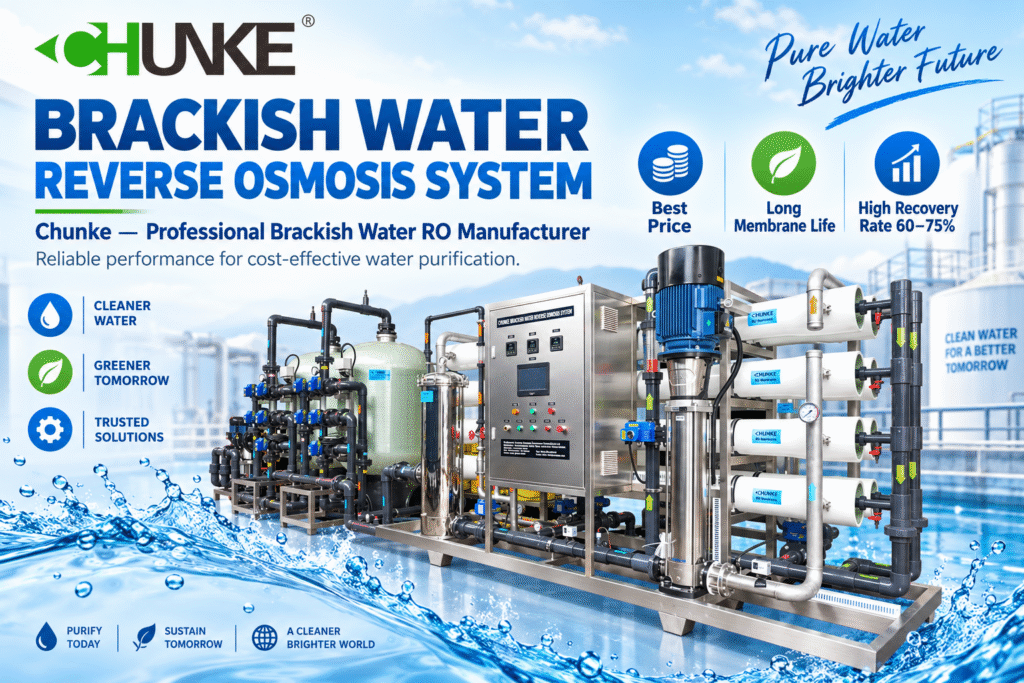
Key Components of a Brackish Water Reverse Osmosis System
A reliable brackish water reverse osmosis system is more than a stack of membranes. Instead, it is an integrated train where every component protects the next. Below, we break down the parts that matter most and the trusted brands Chunke specifies.
RO Membranes and Pressure Vessels
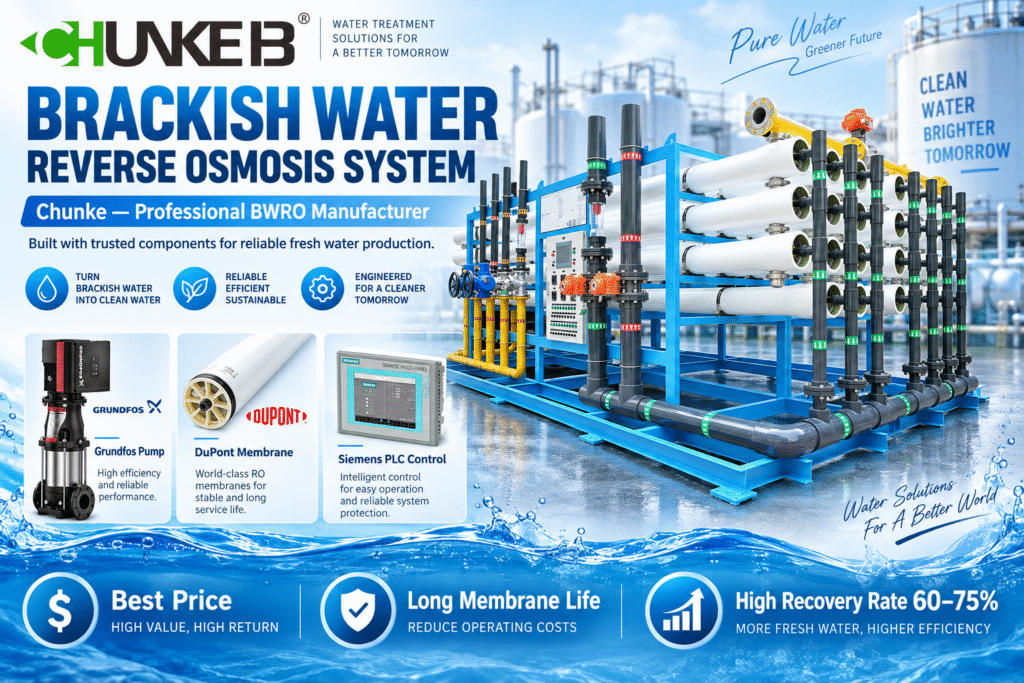
Membranes are the heart of any brackish water reverse osmosis system. Chunke uses proven brackish-water elements from leaders such as DuPont FilmTec, Toray, Hydranautics, and Vontron. These elements deliver high salt rejection and long life on real-world feed water.
Each membrane sits inside an FRP pressure vessel that withstands operating pressure safely. For this, we rely on ROPV membrane housings, which are rated for demanding brackish and desalination duty. Together, quality membranes and vessels set the ceiling for your plant’s performance.
High-Pressure Pumps
Pumps supply the pressure that drives water through the membranes. Because pump reliability defines uptime, Chunke specifies premium brands like Grundfos and CNP, paired with variable frequency drives from suppliers such as Danfoss. A VFD lets the plant adjust pressure to changing salinity, which saves energy and protects the membranes.
Pre-Treatment Equipment
Pre-treatment shields the membranes from fouling and scaling. Depending on your source, it may include multimedia filters, iron and manganese removal, activated carbon, antiscalant dosing, and a 5-micron cartridge filter. When the raw water is turbid or high in organics, we add ultrafiltration (UF) systems ahead of the RO to guarantee stable feed quality.
Instrumentation and Controls
Smart controls turn hardware into a self-managing plant. Chunke integrates flow, pressure, and conductivity instruments from Endress+Hauser, plus PLC and HMI control platforms from Schneider Electric and Siemens. For corrosion-free piping on the permeate side, we use GF Piping Systems (+GF+). As a result, operators see live data and receive alarms before small issues become failures.
How to Size a Brackish Water Reverse Osmosis System
Correct sizing saves money twice: once at purchase, and again every year in operating cost. To size a brackish water reverse osmosis system properly, you need three numbers. First, your feed water TDS and full analysis. Second, your required permeate flow, usually in liters or cubic meters per hour. Third, your target permeate quality.
Feed water salinity sets the recovery rate and pump pressure. At 2,000–3,000 mg/L TDS, a well-designed plant recovers 70–80% of the feed as clean permeate. At 8,000–10,000 mg/L, recovery drops to 55–65% because the reject must carry more salt away. Consequently, higher salinity means a bigger feed pump and slightly higher energy use per cubic meter.
Chunke builds brackish plants from 500 L/h for small workshops up to 100 m³/h and beyond for municipal and industrial projects. For larger duties, our industrial reverse osmosis plant range scales into multi-train configurations. Moreover, we can add a second RO pass or an EDI electrodeionization system when you need ultrapure water for boilers, pharma, or electronics.
Feed Water TDS and Recovery: A Quick Reference
1,000–3,000 mg/L TDS: Low-pressure operation (10–15 bar), 75–80% recovery, lowest energy cost. 3,000–8,000 mg/L TDS: Medium pressure (15–20 bar), 65–75% recovery. 8,000–15,000 mg/L TDS: Higher pressure (20–25 bar), 55–65% recovery, may need energy recovery. Because every borehole differs, always send a water analysis before finalizing a design. In fact, a full lab report is the single most valuable document you can give your supplier.
Pre-Treatment: The Make-or-Break Stage
Most brackish RO failures trace back to weak pre-treatment, not the membranes themselves. Fouling and scaling reduce output, raise pressure, and shorten membrane life. Therefore, matching pre-treatment to your specific feed water is essential, and it is where an experienced manufacturer earns its keep.
Groundwater in many export markets carries high iron, manganese, silica, or hardness. Left untreated, iron stains membranes and hardness forms scale. To prevent this, Chunke designs custom pre-treatment trains: oxidation and filtration for iron, softening or antiscalant dosing for hardness, and carbon for chlorine. For iron-heavy boreholes specifically, our iron filter for well water removes the metals that would otherwise foul the RO.
Hard water deserves special attention because scaling is the silent killer of membranes. When hardness is high, we pair the RO with a hard water treatment system and water softener upstream. This combination keeps the membranes clean, stabilizes recovery, and protects your investment for years.
Brackish Water Reverse Osmosis System Cost
Price is always the first question, so let us be transparent. The cost of a brackish water reverse osmosis system depends on capacity, feed water quality, permeate target, materials, and level of automation. A small 1 m³/h skid costs far less than a 50 m³/h automated municipal plant, yet both follow the same cost logic.
As a rough guide, a compact brackish plant for a small factory or farm starts in the low thousands of US dollars, while large industrial and municipal systems reach six figures. Container packaging, energy recovery, duplex stainless steel, and full remote monitoring all add cost, but each also adds value. For related pricing context, see our desalination plant cost guide and our desalination plant price overview.
Do not judge a plant on purchase price alone. Instead, look at the total cost of ownership over ten years: energy, membrane replacement, chemicals, and downtime. A cheap plant with poor pre-treatment can cost more within two years through membrane damage. Because Chunke designs for low lifetime cost, our systems protect your budget long after commissioning. As always, this is general information, not a formal quotation; contact us for pricing tailored to your project.
Industrial and Municipal Applications
A brackish water reverse osmosis system serves an enormous range of industries. Below are the applications our overseas customers request most, along with why RO fits each one.
Bottling and beverage: Consistent, safe water is the backbone of mineral and drinking water production. Boiler feed and power: High-purity water prevents scale and corrosion; explore our reverse osmosis for boiler feed water solution. Agriculture and greenhouses: Low-salinity water improves crop yield and irrigation reliability. Mining and metals: Process and potable water in remote sites; see our water treatment for mining page.
Farms and rural facilities often rely entirely on brackish boreholes. In those cases, we combine RO with well-water pre-treatment for a turnkey result, as shown on our reverse osmosis system for well water page. Because each application has unique targets, Chunke tailors recovery, materials, and controls to the job rather than forcing a one-size-fits-all box.
Energy Efficiency and Running Costs
Energy is the largest ongoing expense of any brackish water reverse osmosis system, so smart design pays back every month. Because brackish water needs far less pressure than seawater, its energy use is already modest, typically 0.5–1.5 kWh per cubic meter depending on salinity. Still, good engineering trims that number further.
Variable frequency drives are the first win, since they match pump speed to real demand instead of running flat out. Energy recovery devices add a second win on higher-salinity feeds by reusing the pressure in the reject stream. Moreover, correct membrane selection and clean pre-treatment keep the plant operating at its design point, where efficiency is highest. As feed salinity rises, we may also stage the system so each pass works in its ideal pressure band, which lowers total power draw.
For sites with unreliable grid power, solar integration is increasingly attractive. In fact, we offer a solar-powered ultrafiltration and RO system for remote farms and villages that need water where electricity is scarce.
Maintenance and Membrane Life
A brackish water reverse osmosis system is built to run for years, yet simple maintenance decides whether membranes last three years or eight. Fortunately, the routine is light when the plant is well designed. Operators check pressures, flows, and conductivity daily, then log the trends.
Cleaning-in-place (CIP) restores performance when pressure climbs or output falls. With proper antiscalant dosing and pre-treatment, most brackish plants need only occasional CIP cycles. Membranes from top brands such as LG Chem and DuPont typically last five to seven years under good conditions. Cartridge filters, however, are consumables and change every one to three months.
Because we document every plant fully, your team knows exactly what to do and when. We also keep membranes, cartridges, and spare pumps available for our export markets, so a small part never causes a long shutdown. When you need even higher purity downstream, adding an electrodeionization (EDI) system after the RO delivers ultrapure water without chemicals.
How Chunke Builds Your Brackish Water Reverse Osmosis System
Chunke Water Treatment is a professional, system-driven manufacturer based in Guangzhou, China. We are not a price-first trader; instead, we are engineers who design complete water treatment solutions. Every brackish water reverse osmosis system we build starts with your water analysis and ends with a commissioned plant that meets your target.
Our process is straightforward and transparent. First, we study your feed water and application. Next, we propose a design with capacity, recovery, footprint, and component list. Then, we manufacture, factory-test, and pack the unit for export. Finally, we support installation, commissioning, and after-sales service in your country. Throughout, you deal with one accountable team.
Quality control runs through every stage, backed by our Six Sigma discipline. Because we specify premium membranes, pumps, and controls, our plants deliver stable performance in harsh, high-temperature, high-salinity environments. We also document everything, from P&IDs to operation manuals, so your operators run the plant with confidence. To compare configurations, browse our industrial brackish water reverse osmosis systems (BWRO) and our commercial BWRO systems.
For seawater and coastal projects, our sister platform showcases high-recovery desalination expertise; you can review real project references at swro-plant.com seawater and brackish desalination solutions. Whether your source is a borehole or the sea, Chunke has a proven, exportable design ready for your market.
[ 📷 PHOTO 3 — place here. Suggested ALT text: “Chunke engineers testing a brackish water reverse osmosis system before export” ]
How to Choose the Right Brackish Water RO Supplier
Not every supplier can deliver a brackish water reverse osmosis system that lasts. So before you buy, apply a few simple decision criteria that separate real manufacturers from box-movers.
Ask for a water-analysis-based design. A serious supplier never quotes blind; they request your lab report first. Check the component brands. Named membranes, pumps, and controls signal quality, while vague “imported parts” claims do not. Confirm factory testing. A plant should run under load before it ships. Evaluate after-sales support. Membranes, spares, and technical help must be available in your region for years.
Above all, choose a partner who understands your water and your market. Because Chunke has shipped systems across the Middle East, Africa, Southeast Asia, the CIS, and South America, we know the real-world challenges of each region. That experience turns into a plant that simply works when it arrives.
Conclusion: Turn Your Brackish Water Into an Asset
A well-designed brackish water reverse osmosis system converts a problem source into a dependable, low-cost supply of clean water. From bottling and boilers to farms and mines, the technology pays for itself through independence and quality. The keys are the right feed-water analysis, matched pre-treatment, quality components, and a manufacturer who stands behind the design.
Chunke Water Treatment is ready to engineer that system for your exact water and application. Whether you need a compact skid or a containerized municipal plant, we deliver a complete, export-ready solution with premium components and full support. To get a tailored design and quotation, please fill in the contact form on this page and our team will reach out to you shortly.
Written by David, Chunke Water Treatment — Guangzhou Chunke Environmental Technology Co., Ltd.